Heart Attack Recovery: The Complete Guide | Healos™
Heart Attack and Coronary Artery Disease Recovery: The Complete Guide
A heart attack divides life into before and after. In hospital, everything moves fast: the diagnosis, the stent or surgery, the new medicines. Then you go home, and the questions arrive slowly. What actually happened? What should I be doing now? How do I stop it happening again?
This guide pulls the answers together in one place and links to a deeper article on every part of the journey.
Here is the short answer. Coronary artery disease is a slow build-up of inflamed plaque in the heart's arteries, and a heart attack happens when that plaque ruptures and a clot blocks blood flow. Stents, bypass surgery and medicines save lives and lower risk, but about one in five survivors has another major event within a year, and many recovery needs go unmet. A stage-by-stage plan, combining medical care with daily foundations, gives the best long-term outcome.
简短的答案: 心梗把人生分成之前和之后。在医院里一切都很快:诊断、支架或手术、新药;然后你回家,问题才慢慢浮现:到底发生了什么?我现在该做什么?怎样防止再次发生?
本指南把答案集中在一处,并为旅程的每一部分链接一篇更深入的文章。
冠心病是心脏动脉中带炎症的斑块缓慢积累;斑块破裂、血栓堵住血流就发生心梗。支架、搭桥和药物挽救生命、降低风险,但约五分之一的幸存者一年内再次发生主要事件,很多康复需求没有被满足;把医疗照护与每天的基础结合起来的分阶段计划,带来最好的长期结果。
How common is coronary artery disease?
Very. About 8.2% of Canadian adults live with diagnosed ischaemic heart disease (Public Health Agency of Canada), and in the United States the number runs into the tens of millions. In Mexico, heart disease is the leading cause of death, with 192,518 deaths in 2024 (INEGI, 2025). Worldwide, cardiovascular disease causes around one in three deaths (World Heart Federation, 2026).
If you've had a heart attack or stent, you're part of a very large group, and that's useful: it means there is strong evidence about what helps.
冠心病有多常见: 非常常见:约 8.2% 的加拿大成年人确诊缺血性心脏病(加拿大公共卫生署),美国则达数千万人;在墨西哥,心脏病是首要死因,2024 年导致 192,518 人死亡(INEGI 2025);全球约三分之一的死亡由心血管疾病造成(世界心脏联盟 2026)。
如果你经历过心梗或放过支架,你属于一个非常庞大的群体——这也意味着,关于什么有帮助,有充分的证据。
How coronary artery disease develops, and why a heart attack happens
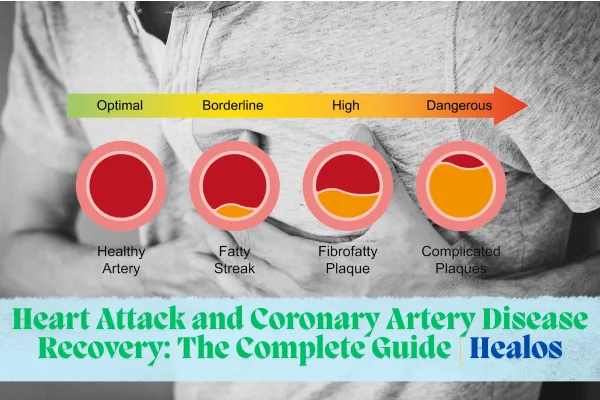
Coronary artery disease starts decades before the first symptom. Cholesterol particles slip into the artery wall, the immune system responds, and a slow cycle of inflammation and oxidative stress builds plaque (see the 10-year cellular timeline). Arteries can widen outward to hide plaque, so blood flow, and how you feel, can stay normal for years.
A heart attack usually happens not because an artery slowly closes, but because an inflamed plaque ruptures and a clot forms on it within minutes. That's why inflammation matters so much, and why it links heart recovery with stroke and congenital heart recovery (see one inflammation, three hearts). What feeds that inner cycle comes from outside: the way we eat, move, sleep and drink, our environment, daily habits, stress and mind-body balance, relationships, how well we understand and follow our care, and our sense of purpose. The Healos™ H-Index groups these into 11 categories, which is why it looks at 32 dimensions of everyday life rather than a single number.
冠心病如何发展,心梗为何发生: 冠心病在第一个症状出现前数十年就开始了:胆固醇颗粒进入动脉壁,免疫系统做出反应,炎症与氧化应激的缓慢循环逐渐形成斑块;动脉可以向外扩张来容纳斑块,所以血流——以及你的感觉——可以多年保持正常。
心梗通常不是因为动脉慢慢堵死,而是带炎症的斑块破裂、几分钟内在其上形成血栓。这就是炎症如此重要的原因,也是它把心脏康复与卒中和先心病康复联系在一起的原因。这个体内循环的燃料来自外部:饮食、运动、睡眠和饮水方式,环境,日常习惯,压力与身心平衡,人际关系,对自身照护的理解与依从,以及生活的意义感。Healos™ H-Index 把这些归纳为 11 大类,这也是它审视日常生活 32 个维度、而不只看一个数字的原因。
Warning signs: when to call 911
Chest pain or pressure, pain spreading to the arm, jaw, neck or back, breathlessness, cold sweat, nausea or sudden unusual fatigue, especially in women, can all signal a heart attack. Call 911 rather than driving yourself. After a stent or heart attack, agree a written plan with your cardiologist about which symptoms mean call 911, which mean call the clinic and which can wait for your next visit.
警示信号:何时拨打 911: 胸痛或胸闷,疼痛放射到手臂、下颌、颈部或背部,气短、冷汗、恶心或突然异常疲劳(女性尤其常见),都可能是心梗信号。请拨打 911,不要自己开车。放支架或心梗后,与心脏科医生约定一份书面计划:哪些症状要打 911,哪些要联系门诊,哪些可以等到下次复诊。
What modern treatment does well
Modern cardiology is at its best in emergencies and in fixing blockages:
Stents (PCI) reopen blocked arteries, and emergency stenting is the standard treatment for a major heart attack.
Bypass surgery (CABG) offers durable protection for complex disease in several arteries, especially with diabetes (see stent vs bypass).
Medicines protect what's been repaired: dual antiplatelet therapy keeps stents open (see DAPT after a stent), statins lower LDL to below about 1.8 mmol/L (see statins for life), and blood pressure medicines reduce strain.
Cardiac rehabilitation reduces cardiovascular death by about a quarter (see cardiac rehab phases).
These are the foundation. Nothing in this guide replaces them.
现代治疗做得好的地方: 现代心脏医学在急救和打通堵塞方面最出色:
支架(PCI)重新打通堵塞的动脉,急诊放支架是重大心梗的标准治疗;
搭桥(CABG)对多支血管复杂病变(尤其合并糖尿病)提供更持久的保护;
药物保护修复的成果——双抗保持支架通畅,他汀把 LDL 降到约 1.8 mmol/L 以下,降压药减轻负担;
心脏康复使心血管死亡减少约四分之一。
这些是基础,本指南的任何内容都不替代它们。
Where recovery still falls short
Even with excellent treatment, the numbers show real gaps:
About 18% of heart attack survivors have another major event within the first year (Jernberg et al., European Heart Journal, 2015).
Only about 24% of eligible US adults attend cardiac rehab (Ritchey et al., 2020), and support usually ends after the last session (see after cardiac rehab ends).
Two years after an acute coronary syndrome, only about 40% of older adults in Ontario were still taking their statin (Jackevicius et al., JAMA, 2002).
Roughly one in five survivors develops major depression (see depression screening after a heart attack), and many live with fear or trauma symptoms (see heart attack PTSD).
Residual inflammation carries risk even when LDL is on target, and many people feel unwell long after "successful" treatment (see why you may still feel this way).
Modern medicine is at its best when it comes to finding problems and saving lives in an emergency. Most of recovery, though, happens in the months and years between appointments.
康复仍然不足的地方: 即使治疗出色,数字也显示出真实的缺口:
约 18% 的心梗幸存者第一年再次发生主要事件(2015);
美国只有约 24% 的合格成人参加心脏康复,支持通常在最后一次课程后结束;
急性冠脉综合征两年后,安大略老年人只有约 40% 仍在服用他汀(JAMA 2002);
约五分之一的幸存者出现重度抑郁,很多人带着恐惧或创伤症状生活;
即使 LDL 达标,残余炎症仍带来风险,很多人在「成功」治疗后很久仍感觉不适。
现代医学最擅长发现问题和抢救;而康复的大部分,发生在复诊之间的数月和数年里。
What fills the gap: daily foundations and structured support
The tools that close these gaps are well established, and they work best together:
Know and track your numbers: blood pressure, LDL, weight, activity and mood (see five numbers to track).
Take medicines consistently, and bring side effects to your team rather than stopping.
Move every day, including strength training once cleared (see strength training after a heart attack).
Eat a Mediterranean-style pattern (see Mediterranean vs DASH vs low-carb).
Protect sleep and check for sleep apnoea (see sleep apnoea after a heart attack).
Treat mood as part of recovery, because in the Healos™ framework the mind-body-spirit state multiplies everything else.
Stay up to date with vaccines (see flu shots after a heart attack).
Healos™ adds structure to all of this. The 91-Day Protocol moves through three stages, Clear, Replenish and Repair, providing complementary cellular nutrition matched to your medication list, with check-ins at days 30, 60 and 91 that turn your numbers, sleep and mood into a summary for your cardiologist. Sovereign Monthly · Recovery continues that support month to month.
如何补上缺口:日常基础与结构化支持: 补上这些缺口的工具早已确立,而且一起使用效果最好:
了解并追踪数字——血压、LDL、体重、活动和情绪;
坚持服药,把副作用带给团队而不是停药;
每天活动,获准后加入力量训练;
采用地中海式饮食;
保护睡眠并检查睡眠呼吸暂停;
把情绪当作康复的一部分——在 Healos™ 框架模型中,身心灵状态是其他一切的乘数;
按时接种疫苗。
Healos™ 为这一切提供结构:91 天方案依次经过减负、补给、修复三个阶段,提供与用药清单匹配的辅助细胞级营养,并在第 30、60、91 天把你的数字、睡眠和情绪整理成给心脏科医生的摘要;Sovereign Monthly · Recovery 按月延续支持。
Your recovery, stage by stage
The first three months: recover safely, organise medicines, start cardiac rehab and learn your numbers. Start with after a stent, five numbers to track and cardiac rehab phases.
Three to twelve months: keep momentum after rehab, rebuild strength, settle eating patterns and look after mood. See after cardiac rehab ends and heart attack PTSD.
The long term: keep LDL and blood pressure on target, stay active, keep follow-up and remember that no symptoms doesn't mean no risk (see no symptoms does not mean no risk).
Every Healos™ guide for heart attack and stent recovery is listed in the library below.
分阶段的康复路线:
头三个月:安全恢复、整理药物、开始心脏康复、了解自己的数字,可从《支架之后》《头 90 天五个数字》《心脏康复三阶段》开始。
3–12 个月:康复结束后保持势头、重建力量、稳定饮食模式、照顾情绪,见《心脏康复结束后》《心梗后 PTSD》。
长期:让 LDL 和血压持续达标、保持活动、坚持随访,并记住没有症状不等于没有风险。所有心梗与支架康复相关的 Healos™ 文章都列在下方的文章库中。
The bottom line
A heart attack is treated in hours, but recovery takes months and protection lasts a lifetime. Modern medicine provides the foundation: stents or bypass, medicines and cardiac rehab. The months and years between appointments are where most of the remaining risk lives, and where daily foundations and structured support make the difference. Use the library below to go deeper into each step.
结论: 心梗在几小时内得到治疗,但康复需要数月,保护则要持续一生。现代医学提供了基础:支架或搭桥、药物和心脏康复;而大部分剩余风险存在于复诊之间的数月和数年里,日常基础和结构化支持在那里发挥作用。用下方的文章库深入了解每一步。
Frequently asked questions
What happens after a heart attack? Most people have a stent or, less often, bypass surgery, then start long-term medicines such as antiplatelets, a statin and blood pressure treatment, and are referred to cardiac rehab. The first year carries the highest risk of another event, so follow-up, medicines and daily habits matter most then.
How long does it take to recover from a heart attack? Many people return to light activity within weeks and complete cardiac rehab over several weeks to months. Full recovery, including fitness, mood and confidence, often takes most of the first year, and protection is lifelong.
How do I prevent another heart attack? Take prescribed medicines consistently, keep LDL below about 1.8 mmol/L and blood pressure on target, attend cardiac rehab, stay active, eat a Mediterranean-style pattern, sleep well, don't smoke and treat depression if it appears.
How common is coronary artery disease? About 8.2% of Canadian adults live with diagnosed ischaemic heart disease, heart disease is Mexico's leading cause of death, and cardiovascular disease causes around one in three deaths worldwide.
常见问题:
心梗后会发生什么?多数人放支架(少数搭桥),开始长期服用抗血小板药、他汀和降压药,并被转介心脏康复;第一年再发风险最高。
心梗恢复要多久?多数人几周内恢复轻度活动,数周到数月完成康复,体能、情绪和信心的完全恢复常需大半年,保护要终身。
怎么预防再次心梗?坚持服药、LDL 低于约 1.8、血压达标、参加康复、活动、地中海饮食、睡好、不吸烟、治疗抑郁。
冠心病有多常见?约 8.2% 的加拿大成年人确诊,心脏病是墨西哥首要死因,全球约三分之一死亡由心血管病造成。
References
Public Health Agency of Canada. Heart disease in Canada: monitoring data (Canadian Chronic Disease Surveillance System, 2023–24).
INEGI. Estadísticas de Defunciones Registradas (EDR) 2024. Comunicado de prensa 142/25, 2025.
World Heart Federation. World Heart Day 2026 Factsheet. 2026.
Jernberg T, et al. Cardiovascular risk in post-myocardial infarction patients. European Heart Journal. 2015;36(19):1163–1170.
Ritchey MD, et al. Tracking cardiac rehabilitation participation and completion among Medicare beneficiaries. Circulation: Cardiovascular Quality and Outcomes. 2020;13(1):e005902.
Jackevicius CA, Mamdani M, Tu JV. Adherence with statin therapy in elderly patients with and without acute coronary syndromes. JAMA. 2002;288(4):462–467.