Stent vs Bypass Surgery: What the Trials Show | Healos™
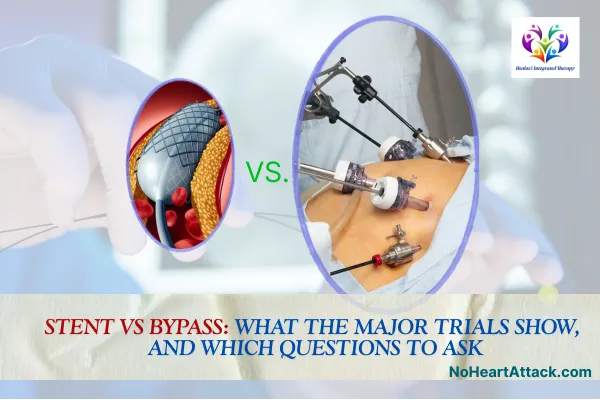
Stent vs Bypass: What the Major Trials Show, and Which Questions to Ask
It's one of the harder conversations in cardiology. The angiogram is done, the images are on the screen, and the cardiologist says something like: "We could treat this with stents, or we could refer you for bypass surgery."
Most people have heard of both. Few know how differently they work, or why the choice depends so much on the pattern of your arteries. And because a stent sounds quicker and gentler, many patients assume it must be the better option.
Here is the short answer. Stents (PCI) and bypass surgery (CABG) both restore blood flow to the heart, but they suit different patterns of disease. In a heart attack, stents are the standard emergency treatment. For complex disease in several arteries, especially with diabetes, major trials found bypass reduced deaths and heart attacks over years, at the cost of a larger operation and a small early stroke risk. For many others, outcomes are similar.
This guide walks through what each procedure does, what the largest trials found, and the questions that help you take part in the decision rather than simply receive it.
简短的答案: 这是心脏科里较难的对话之一:造影做完了,图像在屏幕上,医生说「可以放支架,也可以转去做搭桥」。
多数人听说过两者,却很少人知道它们的原理差别有多大,为什么选择如此取决于血管病变的形态;又因为支架听起来更快更温和,很多人默认它更好。
支架(PCI)和搭桥(CABG)都能恢复心脏供血,但适合不同的病变。心梗急救时支架是标准治疗;多支血管复杂病变、尤其合并糖尿病者,大型试验发现搭桥在数年内减少死亡和心梗,代价是更大的手术和少量早期卒中风险;其他许多患者两者结局相近。
本文说明两种手术的原理、最大型试验的发现,以及能让你参与决策、而不只是被告知决定的问题。
What is the difference between a stent and bypass surgery?
A stent is placed during a catheter procedure called percutaneous coronary intervention, or PCI. A thin tube is threaded from the wrist or groin to the heart, a balloon opens the narrowed section, and a small mesh tube, usually coated with medication, is left behind to hold it open. It treats the narrowing from the inside, one segment at a time.
Bypass surgery, or coronary artery bypass grafting (CABG), is open-heart surgery. The surgeon takes a blood vessel from the chest wall, arm or leg and connects it so that blood flows around the blockage. An artery from inside the chest wall, the internal mammary artery, is usually used for the most important vessel on the front of the heart because it stays open for many years.
That difference explains a lot. A stent fixes the specific narrowing it's placed in. A bypass graft creates a new route that also protects the heart muscle beyond it if new narrowings develop further up the original artery. Neither one removes atherosclerosis from the rest of the arterial tree (see the 10-year cellular timeline).
支架和搭桥有什么区别: 支架是在经皮冠状动脉介入(PCI)中放置的:细导管从手腕或腹股沟送到心脏,球囊撑开狭窄段,留下一根通常带药物涂层的网状管支撑血管,它从内部一段一段地处理狭窄。
搭桥(CABG)是开胸手术:外科医生取胸壁、手臂或腿部的血管,接成一条绕过堵塞的新通路;心脏前壁最重要的血管通常用胸廓内动脉(乳内动脉)搭桥,因为它能通畅很多年。
这一区别解释了很多事:支架修复它所在的那一处狭窄;搭桥则建立新通路,即使原血管上游出现新的狭窄,下游心肌也受保护。两者都不能清除其余动脉中的粥样硬化。
In a heart attack, stents come first
If you're having an ST-elevation heart attack, the priority is opening the blocked artery as fast as possible, and emergency PCI with a stent is the standard treatment where it's available. Bypass surgery is rarely the first step in that situation, though it may be recommended later if the angiogram shows extensive disease in other arteries.
So the stent-versus-bypass question usually arises in one of two settings: after the emergency has been treated and the remaining arteries are assessed, or in planned treatment for people with stable symptoms and significant narrowing in several vessels.
心梗急救时,支架优先: 如果发生 ST 段抬高型心梗,首要任务是尽快打通堵塞血管,在有条件的地方,急诊 PCI 放支架是标准治疗;这种情况下搭桥很少是第一步,但如果造影显示其他血管有广泛病变,之后可能会建议搭桥。因此「支架还是搭桥」通常出现在两种场景:急救处理后评估其余血管时,或症状稳定、多支血管明显狭窄的计划性治疗中。
What the major trials show: SYNTAX, FREEDOM and left main disease
SYNTAX: complex disease in several arteries. This landmark trial randomised 1,800 patients with three-vessel or left main disease to stents or bypass. At one year, major adverse cardiac and cerebrovascular events were 17.8% with stents versus 12.4% with bypass, mainly because stent patients more often needed repeat procedures. Stroke, however, was more common after bypass: 2.2% versus 0.6% (Serruys et al., NEJM, 2009). Ten years later, among patients with three-vessel disease, 28% had died after stents compared with 21% after bypass, while in left main disease there was no significant difference (Thuijs et al., SYNTAXES, Lancet, 2019).
FREEDOM: diabetes and multivessel disease. People with diabetes tend to have more diffuse disease. In FREEDOM, the five-year rate of death, heart attack or stroke was 26.6% with stents versus 18.7% with bypass. Stroke was again higher after bypass, 5.2% versus 2.4% (Farkouh et al., NEJM, 2012). This trial is the main reason guidelines often favour bypass for people with diabetes and disease in several arteries.
Left main disease: closer results. Trials such as EXCEL and NOBLE compared the two approaches for narrowing in the left main artery with low to intermediate complexity. Results were mixed: broadly similar rates of the combined outcome in EXCEL, more repeat procedures and heart attacks after stents in NOBLE, with trade-offs in both directions.
Stable disease without complex anatomy. For many people with stable symptoms, the question isn't stent versus bypass at all. In the ISCHEMIA trial, an initial invasive strategy (stents or bypass) did not reduce heart attacks or death overall compared with medication and lifestyle treatment, although procedures relieved angina more effectively (Maron et al., NEJM, 2020).
大型试验怎么说: SYNTAX(多支血管复杂病变):1,800 名三支或左主干病变患者随机接受支架或搭桥。一年时主要心脑血管不良事件支架组 17.8%、搭桥组 12.4%,主要因为支架组更常需要再次手术;但卒中在搭桥后更多(2.2% vs 0.6%)。十年随访中,三支病变患者支架组死亡 28%、搭桥组 21%,左主干病变无显著差异。
FREEDOM(糖尿病合并多支病变):五年死亡、心梗或卒中支架组 26.6%、搭桥组 18.7%,卒中仍是搭桥后更多(5.2% vs 2.4%),这是指南常对糖尿病多支病变倾向搭桥的主要依据。
左主干病变:EXCEL、NOBLE 等试验比较了低中复杂度左主干病变,结果不一,各有取舍。
稳定且解剖不复杂的病变:很多时候问题根本不是二选一——ISCHEMIA 试验中,初始介入策略总体上并未比药物和生活方式治疗减少心梗或死亡,但更能缓解心绞痛。
Why your heart team may recommend one over the other
Guidelines recommend that decisions for complex coronary disease be made by a heart team, usually an interventional cardiologist and a cardiac surgeon reviewing the case together, ideally with your input (Lawton et al., 2021 ACC/AHA/SCAI Revascularization Guideline, Circulation, 2022). The main factors they weigh include:
How many arteries are involved, and where. Disease in all three major arteries or the left main points more often toward bypass.
How complex the blockages are. Doctors often calculate a SYNTAX score from the angiogram. Higher scores, meaning longer, calcified or branching lesions, tend to favour bypass.
Diabetes, which generally favours bypass in multivessel disease.
Heart pumping function, since weaker heart muscle can shift the balance.
Your overall surgical risk: age, frailty, lung and kidney disease, previous heart surgery.
Your priorities: a faster recovery now, or fewer repeat procedures later.
There's rarely one "right" answer for everyone. There is usually a better answer for you, and understanding these factors helps you see why it was recommended.
心脏团队为何会推荐其中一种: 指南建议复杂冠心病的决策由「心脏团队」做出,通常是介入心脏科医生和心外科医生共同审阅病例,理想情况下也听取你的意见(2021 ACC/AHA/SCAI 血运重建指南)。
主要考量:受累血管的数量和位置(三支或左主干病变更常倾向搭桥);病变复杂程度(医生常根据造影计算 SYNTAX 评分,病变长、钙化、分叉者评分高,倾向搭桥);糖尿病(多支病变时通常倾向搭桥);心脏泵血功能;整体手术风险(年龄、衰弱、肺肾疾病、既往心脏手术);你的优先考虑(现在恢复快,还是日后少做手术)。
很少有对所有人都「正确」的答案,但通常有对你更好的答案,理解这些因素能帮你明白为何被这样推荐。
Recovery compared: days versus weeks
The difference in recovery is real and worth planning for.
After a stent, most people go home within a day or two and return to light activity within days. The big priorities are taking dual antiplatelet therapy without interruption and joining cardiac rehab (see after a stent).
After bypass surgery, a hospital stay of about five to seven days is typical, and full recovery usually takes six to twelve weeks. The breastbone needs roughly six to eight weeks to knit together, which limits lifting, pushing and driving for a period your surgical team will specify. Fatigue, poor sleep and low mood are common in the first weeks.
Both paths lead to the same place: long-term medications, cardiac rehab and lifestyle work. The procedure is the beginning of recovery, not the end of it (see after cardiac rehab ends).
恢复对比:几天 vs 几周: 恢复差别是真实的,值得提前规划。支架后多数人一两天内出院,几天内恢复轻度活动,重点是不间断地服用双联抗血小板药并参加心脏康复。搭桥后通常住院五到七天,完全恢复一般需要六到十二周;胸骨大约需要六到八周愈合,在外科团队规定的时间内限制提重物、推拉和驾驶;头几周常见疲劳、睡眠差和情绪低落。两条路最终通向同一个地方:长期服药、心脏康复和生活方式调整。手术是康复的开始,而不是结束。
Ten questions to ask your heart team
How many of my arteries are narrowed, and where?
What is my SYNTAX score, and what does it mean in my case?
Does my diabetes, kidney function or heart pumping strength change the recommendation?
What are the chances I'll need another procedure in the next five years with each option?
What is my personal risk of stroke or other complications with surgery?
Would medication alone be reasonable for me right now?
If bypass, which vessels would be used as grafts?
What would recovery look like for me, given my work and home situation?
Have both an interventional cardiologist and a cardiac surgeon reviewed my case?
Whatever we choose, what should I be doing afterwards to protect the rest of my arteries?
It's completely reasonable to ask for time to think, to bring a family member, or to request a second opinion for a planned, non-emergency procedure.
可以问心脏团队的十个问题:
① 我有几支血管狭窄,在哪里?
② 我的 SYNTAX 评分是多少,对我意味着什么?
③ 糖尿病、肾功能或心脏泵血功能会改变建议吗?
④ 两种方案未来五年需要再次手术的可能性各是多少?
⑤ 我做手术的卒中或其他并发症风险是多少?
⑥ 目前单用药物治疗对我是否合理?
⑦ 如果搭桥,会用哪些血管?
⑧ 结合我的工作和家庭情况,恢复会是什么样?
⑨ 我的病例是否由介入心脏科医生和心外科医生共同审阅?
⑩ 无论选哪种,之后我该做什么来保护其余的动脉?对计划性、非急诊手术,要求时间考虑、带家人一起或寻求第二意见都完全合理。
How Healos™ can help you prepare
Healos™ doesn't recommend procedures, and it isn't involved in treatment decisions. Where it can help is in preparing for the conversation and in what comes after it.
The H-Index Full Report turns a structured 32-dimension audit across 11 lifestyle and health categories, including your medications, symptoms, activity, sleep and mood, into a summary formatted for your cardiologist or surgeon, with space for the questions above. It's a pre-visit communication tool, not a diagnostic test. After your procedure, whichever it is, Healos™ programmes provide complementary nutritional and lifestyle support alongside your cardiac care.
Healos 如何帮你准备: Healos™ 不推荐手术方式,也不参与治疗决策;它能帮助的是这场对话的准备,以及之后的阶段。H-Index™ 完整报告把覆盖 11 大类、32 个维度的结构化健康审计(包括用药、症状、活动、睡眠和情绪)整理成给心脏科或心外科医生的摘要,并留出上述问题的位置。它是就诊前沟通工具,不是诊断工具。无论做哪种手术,术后 Healos™ 方案都提供与心脏诊疗并行的辅助营养与生活方式支持。
The bottom line
Stents and bypass surgery aren't rivals; they're tools for different situations. Stents are the emergency standard and a good choice for many planned cases. Bypass tends to offer more durable protection for complex disease in several arteries, especially with diabetes, in exchange for a bigger operation and a longer recovery. The best decision comes from a heart team that knows your anatomy and a patient who knows the right questions to ask.
结论: 支架和搭桥不是对手,而是适用于不同情况的工具:支架是急救标准,也是很多计划性治疗的好选择;搭桥往往为多支血管复杂病变(尤其合并糖尿病)提供更持久的保护,代价是更大的手术和更长的恢复。最好的决定,来自了解你血管情况的心脏团队,和懂得提出正确问题的患者。
Frequently asked questions
Should I get a stent or bypass surgery? It depends on how many arteries are narrowed, how complex the blockages are, whether you have diabetes, your heart function and your surgical risk. Stents are standard in a heart attack and suit many planned cases; bypass often offers more durable results for complex disease in several arteries. The decision is best made with a heart team.
Is bypass surgery better than stents for people with diabetes? For people with diabetes and disease in several arteries, the FREEDOM trial found bypass reduced the five-year rate of death, heart attack or stroke (18.7% vs 26.6% with stents), although stroke itself was more common after bypass. Guidelines often favour bypass in this group, but individual factors still matter.
What did the SYNTAX trial show? In 1,800 patients with three-vessel or left main disease, stents led to more repeat procedures and more major events at one year, while bypass had more early strokes. At 10 years, death was lower after bypass in three-vessel disease (21% vs 28%), with no significant difference in left main disease.
How long is recovery after bypass compared with a stent? After a stent, most people go home within a day or two and resume light activity within days. After bypass, a hospital stay of about five to seven days is typical and full recovery usually takes six to twelve weeks, with lifting and driving restricted while the breastbone heals.
What is a heart team? A heart team is a group, usually including an interventional cardiologist and a cardiac surgeon, that reviews complex coronary disease together to recommend the best treatment. Guidelines recommend this approach for patients with complex disease.
常见问题:
放支架还是搭桥?取决于狭窄血管数量、病变复杂程度、是否有糖尿病、心功能和手术风险;支架是心梗急救标准并适合许多计划性治疗,搭桥对多支复杂病变往往更持久,最好由心脏团队决定。
糖尿病患者搭桥更好吗?FREEDOM 试验中糖尿病多支病变患者搭桥五年死亡、心梗或卒中更少(18.7% vs 26.6%),但卒中更多,指南常倾向搭桥,仍需考虑个人因素。
SYNTAX 试验显示什么?支架一年内再手术和主要事件更多,搭桥早期卒中更多;十年时三支病变搭桥死亡更低(21% vs 28%),左主干无显著差异。
恢复时间对比?支架一两天出院、数天恢复轻度活动;搭桥住院约五到七天,完全恢复六到十二周。
什么是心脏团队?通常由介入心脏科医生和心外科医生共同审阅复杂病例、推荐最佳治疗。
References
Serruys PW, et al. Percutaneous coronary intervention versus coronary-artery bypass grafting for severe coronary artery disease (SYNTAX). New England Journal of Medicine. 2009;360:961–972.
Thuijs DJFM, et al. Percutaneous coronary intervention versus coronary artery bypass grafting in patients with three-vessel or left main coronary artery disease: 10-year follow-up of the multicentre randomised controlled SYNTAX trial. Lancet. 2019;394:1325–1334.
Farkouh ME, et al. Strategies for multivessel revascularization in patients with diabetes (FREEDOM). New England Journal of Medicine. 2012;367:2375–2384.
Stone GW, et al. Five-year outcomes after PCI or CABG for left main coronary disease (EXCEL). New England Journal of Medicine. 2019;381:1820–1830.
Holm NR, et al. Percutaneous coronary angioplasty versus coronary artery bypass grafting in the treatment of unprotected left main stenosis: updated 5-year outcomes from the randomised, non-inferiority NOBLE trial. Lancet. 2020;395:191–199.
Maron DJ, et al. Initial invasive or conservative strategy for stable coronary disease (ISCHEMIA). New England Journal of Medicine. 2020;382:1395–1407.
Lawton JS, et al. 2021 ACC/AHA/SCAI Guideline for Coronary Artery Revascularization. Circulation. 2022;145(3):e18–e114.
Custom HTML/CSS/JavaScript