FOR LTC & SENIOR CARE INSTITUTIONS · B2B PROGRAMME
Your waiting list is
1,000 people long.
Your beds won't open
until patients improve.
The LTC capacity crisis is not a bed problem. It is a patient turnover problem. When existing residents plateau on inflammation markers, can't meet discharge thresholds, and transfer to hospital at high rates — no number of new beds fixes the waiting list. Healos™ addresses the cellular health of your highest-risk residents, so the beds can move.
1000+
Waiting list per
typical 100-bed
LTC institution
5–7yr
Average Ontario
wait time
(was 2–3 years)
20
High-risk patients
in the Healos™
Trial proposal
100+
Patients per
institution
at contract stage
| ~68% of cardiac residents | On statins — CoQ10 depleted 40–50%. Fatigue prevents rehab completion. |
| ~52% on loop diuretics | K · Mg · Thiamine depleted. Electrolyte-driven arrhythmia and weakness. |
| 40–50% of cardiac patients | Clinical fear of recurrence. Untracked. Multiplies all other risk (×0.4). |
| Complex polypharmacy | 3–6 concurrent medications typical. Drug-nutrient conflicts compound. |
| No GP access (6.5M Canadians) | Residents waiting for LTC often have no regular physician to intercept decline. |
| Healos™ Trial: 20 patients | Targets all five mechanisms simultaneously. 3-month measurable outcome. |
🛡 All protocols pharmacist-reviewed against complex polypharmacy regimens 📋 Monthly H-Index report for every enrolled resident — shareable with clinical team
🔒 HIPAA & PIPEDA · Private Firestore Vault per resident 📊 Contractual inflammation targets — measurable, verifiable outcomes
THE STRUCTURAL CRISIS - THE NUMBERS
The Waiting List Won't Shorten
Until Your Current Residents Get Better.
These are the structural conditions driving the LTC capacity crisis. Healos™ is designed specifically for this gap
— not as wellness, but as a measurable cellular health intervention for your highest-risk residents.
1,000+
Waiting list per 100-bed LTC institution in many Ontario regions
5–7yr
Current average Ontario LTC wait time — up from 2–3 years
6.5 M
Canadians without a registered family physician (2024)
40 - 50%
CoQ10 depletion in statin patients — the primary energy deficit driving care burden
The mechanism: When LTC residents have unaddressed drug-nutrient depletions, subclinical chronic inflammation, and mitochondrial energy deficits — they do not meet discharge criteria, they transfer to hospital at higher rates, and they require more intensive nursing intervention per day. Each of these outcomes directly lengthens your waiting list and increases your per-resident care cost. Healos™ addresses all three mechanisms simultaneously in a structured, pharmacist-reviewed, monthly-tracked program.
THE HEALOS™ LTC TRIAL PROPOSAL
20 high-risk residents. 3 months.
Measurable outcomes before you commit to anything larger.
The Trial is structured to protect your institution. You select the patients. You set the
outcome expectations. We deliver the data. The long-term contract is conditional on
hitting the agreed targets.
The 20-Patient · 3-Month · LTC Trial
Structured to demonstrate measurable outcome before full institutional commitment
WHAT THE TRIAL MEANS FOR EACH DECISION-MAKER
CEO / EXECUTIVE DIRECTOR
ROI & competitive positioning
- Measurable reduction in per-resident nursing intervention frequency
- Inflammation marker improvement documented in clinical record
- First LTC institution in region offering structured cellular health — market differentiation
- Data package for regulatory and board reporting on care quality
DIRECTOR OF CARE (DOC)
Clinical outcomes & care burden
- Monthly H-Index report per resident — clinical picture between physician visits
- hs-CRP and CoQ10 blood panel before/after comparison at Day 91
- Drug-nutrient interaction review flagging unaddressed polypharmacy gaps
- AI-automated daily tracking — near-zero additional nursing workload
DIRECTOR OF FINANCE (DOF)
Cost analysis & contract terms
- Trial cost per resident: substantially below one acute-care transfer event
- Long-term contract pricing: per-resident monthly fee, volume-discounted at 100+ patients
- Administrative cost: near-zero due to AI automation (no additional headcount)
- Contract conditional on agreed inflammation and care-intensity targets being met
We will respond personally within 48 hours · Proposal includes full pricing, target metrics, and contract terms
INSTITUTIONAL ECONOMICS
The economics of the Healos™ institutional model
How the Healos™ Sovereign Node partnership changes the economics of long-term care delivery
— for institutions that integrate it as a structured resident health programme.
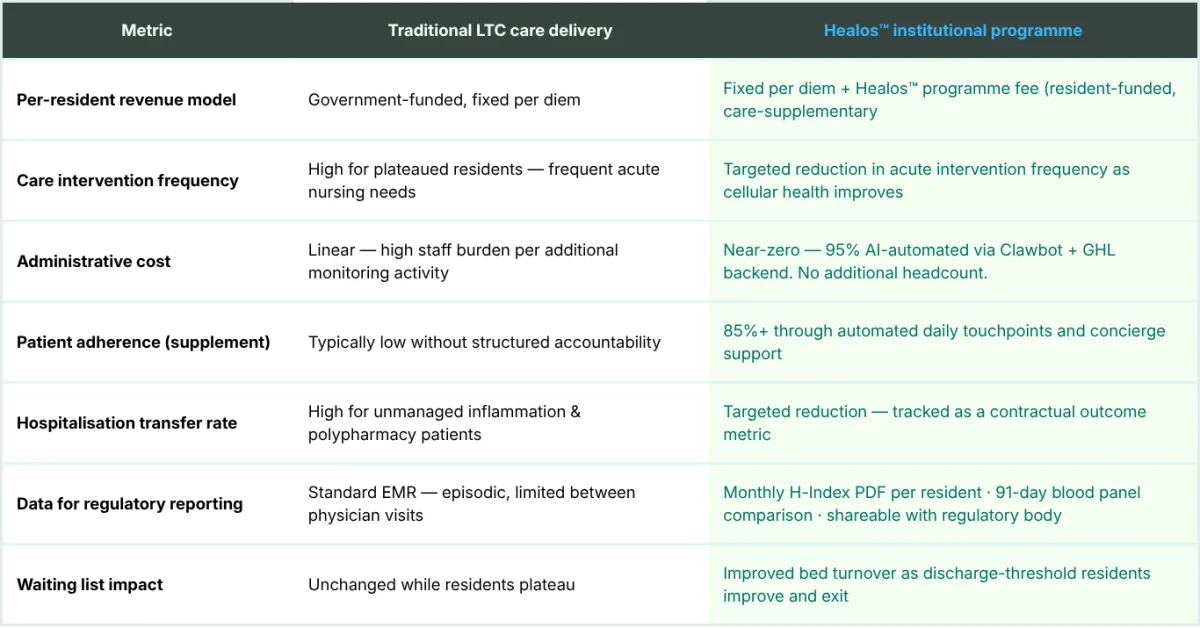
Institutional partnership enquiries: Healos™ is building a network of institutional LTC partners across Ontario and Canada. The Trial is the entry point — the long-term contract (average 100+ residents per institution) is what the partnership becomes. Contact us directly for a proposal specific to your institution's size, patient population, and current care metrics.
Healos™ Patient Programmes
Heart Attack, Stroke and ACHD: The Shared Root | Healos™
One Inflammation, Three Hearts: The Shared Root of Heart Attack, Stroke and Congenital Heart Disease
A heart attack in a 62-year-old, a stroke in a 70-year-old and a repaired congenital heart in a 30-year-old seem to have little in common. They have different specialists, different scans and different medicines. Yet underneath, they share more than most people realise.
Here is the short answer. Heart attack, stroke and congenital heart disease look different, but they share a biology: chronic low-grade inflammation and oxidative stress, which damage blood vessels and heart and brain tissue. That inner pathway is fed by everyday outer factors, from diet, sleep and activity to stress, environment and relationships. Modern medicine treats each condition; the shared root is where daily foundations make the difference.
This article is the hub of the Healos™ blog. It explains the shared root, then points you to the complete guide for your own situation.
简短的答案: 62 岁的心梗、70 岁的卒中、30 岁修复过的先天性心脏,看起来没什么共同点:专科不同、检查不同、药物也不同,但在底层,它们的共同之处比多数人以为的多。心梗、卒中和先心病有共同的生物学:慢性低度炎症与氧化应激,损伤血管以及心脏和大脑组织;这条体内通路由日常外部因素推动——从饮食、睡眠、运动到压力、环境和人际关系。现代医学分别治疗每种疾病,而共同根源正是日常基础发挥作用的地方。本文是 Healos™ 博客的总枢纽:先讲清共同根源,再指引你去读适合自己情况的完整指南。
From everyday life to the heart and brain: the causal chain
It helps to think of heart and brain disease as a chain with four links:
Outer factors. What we eat and drink, how we move and sleep, our environment and daily habits, stress and mind-body balance, relationships, how well we understand and follow our care, and our sense of purpose. The Healos™ H-Index groups these into 11 categories.
The inner pathway. Those factors, along with blood pressure, LDL cholesterol, blood sugar, smoking, surgery and age, push the body toward chronic low-grade inflammation and oxidative stress.
Tissue damage. Inflamed artery walls build and destabilise plaque; strained heart muscle and brain tissue lose resilience.
Events and conditions. Heart attacks, strokes, heart failure and the slow decline that can follow heart surgery.
Medicine works mainly on links 3 and 4, and on key drivers in link 2 such as blood pressure and LDL. Daily foundations work on links 1 and 2, every day.
从日常生活到心脏和大脑:因果链: 把心脑疾病想成一条四环相扣的链会很有帮助:① 外部因素——吃喝、活动与睡眠、环境与日常习惯、压力与身心平衡、人际关系、对自身照护的理解与依从、生活的意义感,Healos H-Index 把它们归为 11 大类;② 体内通路——这些因素连同血压、LDL、血糖、吸烟、手术和年龄,把身体推向慢性低度炎症与氧化应激;③ 组织损伤——发炎的动脉壁形成并使斑块不稳定,承压的心肌和脑组织失去韧性;④ 事件与疾病——心梗、卒中、心衰,以及心脏手术后可能出现的缓慢衰退。医学主要作用于第 3、4 环,以及第 2 环中血压和 LDL 等关键驱动因素;日常基础则每天作用于第 1、2 环。
Does inflammation really matter? What the evidence shows
For decades, cholesterol got most of the attention. The evidence now shows inflammation carries risk of its own:
In CANTOS, heart attack survivors whose cholesterol was already treated had about 15% fewer repeat cardiovascular events when inflammation alone was lowered (Ridker et al., NEJM, 2017).
In LoDoCo2, low-dose colchicine, an anti-inflammatory medicine, reduced cardiovascular events by about 31% in people with chronic coronary disease (Nidorf et al., NEJM, 2020). It's now a prescription option some cardiologists use.
In stroke, inflammation drives damage in the days after the event and shapes recovery (see what happens to your brain after a stroke).
In adult congenital heart disease, higher hs-CRP, a blood marker of inflammation, has been linked to a higher risk of death and heart failure events (Opotowsky et al., European Heart Journal, 2018).
In prevention, the process starts early: in the PESA study, 63% of symptom-free adults aged 40 to 54 already had plaque (Fernández-Friera et al., Circulation, 2015).
炎症真的重要吗:证据怎么说: 几十年来胆固醇得到了大部分关注,而如今证据表明炎症本身也带有风险:CANTOS 中,胆固醇已得到治疗的心梗幸存者仅降低炎症,再发心血管事件就减少约 15%(NEJM 2017);LoDoCo2 中,低剂量秋水仙碱(一种抗炎药)使慢性冠心病患者心血管事件减少约 31%(NEJM 2020),现已是部分心脏科医生使用的处方选择;卒中后数天内炎症推动损伤并影响恢复;成人先心病中较高的 hs-CRP 与死亡和心衰事件风险升高相关(Eur Heart J 2018);在预防人群中这一过程开始得很早——PESA 研究中 40–54 岁无症状成人 63% 已有斑块(Circulation 2015)。
Same root, different branches
A shared root doesn't mean identical care. Each group has priorities that only its specialists can manage, summarised in the table:
After a heart attack or stent: LDL targets, uninterrupted antiplatelet therapy, cardiac rehab.
After a stroke: blood pressure control, clot prevention matched to the cause, rehabilitation that drives rewiring.
With congenital heart disease: lifelong ACHD follow-up, fluid limits, rhythm and valve monitoring.
For prevention: screening and reaching targets for blood pressure, LDL and blood sugar, especially after 50 or with a family history.
The branches are where medicine leads. The root is where everyday life does.
同一根源,不同枝干: 共同根源不等于完全相同的照护,每类人群都有只能由其专科管理的重点(见表):心梗或支架后——LDL 目标、不间断的抗血小板治疗、心脏康复;卒中后——血压控制、按病因匹配的防血栓治疗、推动重组的康复;先心病——终身 ACHD 随访、液体限制、心律与瓣膜监测;预防——筛查并达到血压、LDL 和血糖目标,尤其 50 岁以上或有家族史者。枝干由医学主导,根源则由日常生活决定。
What helps the shared root
The same daily foundations calm inflammation and oxidative stress across all three groups: regular movement within your team's guidance, seven to nine hours of sleep and checking for sleep apnoea, a Mediterranean-style eating pattern, not smoking, moderate or no alcohol, stress care and social connection, and taking prescribed medicines consistently. Several heart medicines, including statins, also reduce inflammation.
In the Healos™ framework, mind-body-spirit state acts as a multiplier on all of these: the same habits deliver more when mood and stress are looked after, and less when they aren't.
Modern medicine is irreplaceable for diagnosis, emergencies and surgery. Healos™ is built to cover what medicines and procedures aren't designed to do: nutrients commonly depleted by surgery and medications, the body's oxidative load, and the everyday factors between appointments. The 91-Day Protocol moves through Detox, Replenish and Repair, three stages of complementary cellular nutrition, with follow-ups at day 30 and day 60 (with a reminder to book your blood test) and a blood-test report review at day 90. Every plan is matched to your medication list and runs alongside your specialist care.
什么有助于照顾共同根源: 同样的日常基础能在三类人群中平息炎症和氧化应激:在团队指导下规律活动、睡 7–9 小时并检查睡眠呼吸暂停、地中海式饮食、不吸烟、适度饮酒或不饮酒、压力管理与社交联结,以及坚持服用处方药——包括他汀在内的多种心脏药物也能降低炎症。在 Healos™ 框架模型中,身心灵状态是这一切的乘数:情绪和压力被照顾好时,同样的习惯效果更好。现代医学在诊断、急救和手术上不可替代;Healos 补上药物和手术本来不负责的部分:手术与常用药物消耗的营养素、体内的氧化负担,以及复诊之间的日常因素。91 天方案依次经过排毒、补给、修复三个阶段,提供辅助的细胞级营养,第 30 天跟进、第 60 天跟进并提醒验血、第 90 天验血报告解读;每个方案都与你的用药清单匹配,并与专科诊疗并行。
Start here: find the guide for your situation
Each of the four complete guides below explains one group in depth and links to every related article:
从这里开始:找到适合你的指南: 下面四篇完整指南各深入讲解一类人群,并链接到所有相关文章:心梗、支架或搭桥康复;卒中康复;成人先天性心脏病;50 岁以上或有家族史的心脏病预防。
The bottom line
Three diagnoses, one shared root. Chronic inflammation and oxidative stress connect heart attack, stroke and congenital heart disease, and they're fed by the everyday factors we can change. Let your specialists lead on the branches, give the root daily attention, and start with the guide that fits your situation.
结论: 三种诊断,一个共同根源。慢性炎症与氧化应激把心梗、卒中和先心病连在一起,而推动它们的,正是我们可以改变的日常因素。让专科医生主导各自的「枝干」,每天照顾好「根」,并从适合你的那篇指南开始。
Frequently asked questions
Is heart disease caused by inflammation? Inflammation is one of the core drivers, alongside LDL cholesterol, blood pressure and other risk factors. Trials such as CANTOS and LoDoCo2 showed that lowering inflammation reduces cardiovascular events even when cholesterol is already treated.
What do heart attack, stroke and congenital heart disease have in common? They share a biology of chronic low-grade inflammation and oxidative stress, which damages blood vessels and heart and brain tissue, and which is fed by everyday factors such as diet, sleep, activity, stress and environment.
How can I lower inflammation after a heart attack or stroke? Take prescribed medicines consistently (statins also reduce inflammation), move regularly within your team's guidance, sleep well, eat a Mediterranean-style pattern, don't smoke, limit alcohol and look after stress and mood. Some people are prescribed colchicine by their cardiologist.
Does congenital heart disease involve inflammation? Often. Repeated surgery, long-term strain on a repaired heart and acquired risk factors can all feed it, and higher hs-CRP has been linked to worse outcomes in adults with congenital heart disease.
常见问题:
心脏病是炎症引起的吗?炎症是核心驱动之一,与 LDL、血压等并列,CANTOS 和 LoDoCo2 显示即使胆固醇已治疗,降低炎症仍减少事件。
三者有什么共同点?共享慢性低度炎症与氧化应激的生物学,由饮食、睡眠、活动、压力和环境等日常因素推动。
心梗或卒中后怎么降低炎症?坚持服药(他汀也降炎症)、活动、睡好、地中海饮食、不吸烟、限酒、照顾情绪,部分人会被处方秋水仙碱。
先心病有炎症吗?常有,多次手术、长期负担和获得性风险都会助长,hs-CRP 较高与更差结局相关。
References
Ridker PM, et al. Antiinflammatory therapy with canakinumab for atherosclerotic disease (CANTOS). New England Journal of Medicine. 2017;377:1119–1131.
Nidorf SM, et al. Colchicine in patients with chronic coronary disease (LoDoCo2). New England Journal of Medicine. 2020;383:1838–1847.
Opotowsky AR, et al. Prospective cohort study of C-reactive protein as a predictor of clinical events in adults with congenital heart disease. European Heart Journal. 2018;39(34):3253–3261.
Fernández-Friera L, et al. Prevalence, vascular distribution, and multiterritorial extent of subclinical atherosclerosis (PESA). Circulation. 2015;131(24):2104–2113.
Iadecola C, Anrather J. The immunology of stroke: from mechanisms to translation. Nature Medicine. 2011;17(7):796–808.
Healos™ Canada — Integrative cellular recovery for post-cardiac, post-stroke, and ACHD patients.
Canada.USA.Mexico.Japan.China.Singapore.Australia...
SMS & voicemail: 365.909.2567
Ottawa, Ontario, Canada
PATIENT SERVICES


© 2026 Healos™ Canada · NoHeartAttack.com · Ottawa, Ontario Privacy - Terms - Refunds
Healos™ programmes are dietary supplements and integrative wellness services. They are not medical advice, not medical treatment, and not a substitute for professional medical care.
Always consult your physician, cardiologist, or pharmacist before starting any new supplement programme. In case of cardiac emergency, call 911 immediately. Healos™ Canada