THE STRUCTURAL REALITY & PRIVATE SENIOR LIVING · US
Your residents' families chose you because they expect more than management.
The data says they're watching closely.
Healos™ cellular nutrition program for private Assisted Living & Memory Care · Florida & New York
91
Day Program ·
20
High-risk residents
20
Measurable Outcomes
| ~68% of cardiac residents | On statins — CoQ10 depleted 40–50%. Fatigue prevents rehab completion. |
| ~52% on loop diuretics | K · Mg · Thiamine depleted. Electrolyte-driven arrhythmia and weakness. |
| 40–50% of cardiac patients | Clinical fear of recurrence. Untracked. Multiplies all other risk (×0.4). |
| Complex polypharmacy | 3–6 concurrent medications typical. Drug-nutrient conflicts compound. |
| No GP access (6.5M Canadians) | Residents waiting for LTC often have no regular physician to intercept decline. |
| Healos™ Trial: 20 patients | Targets all five mechanisms simultaneously. 3-month measurable outcome. |
🛡 All protocols pharmacist-reviewed against complex polypharmacy regimens 📋 Monthly H-Index report for every enrolled resident — shareable with clinical team
🔒 HIPAA & PIPEDA · Private Firestore Vault per resident 📊 Contractual inflammation targets — measurable, verifiable outcomes
THE STRUCTURAL CRISIS - THE NUMBERS
The Waiting List Won't Shorten
Until Your Current Residents Get Better.
These are the structural conditions driving the LTC capacity crisis. Healos™ is designed specifically for this gap
— not as wellness, but as a measurable cellular health intervention for your highest-risk residents.
87.9%
· US assisted living occupancy 2026 — revenue lost in the empty 12.1%
22 months
Average resident length of stay — shortened by unmanaged decline
41%
Annual staff turnover rate — driven by reactive, high-intensity care burden
$5,419/mo
Median private-pay monthly fee — at risk when families move loved ones out
The mechanism: When AL and memory care residents have unaddressed drug-nutrient depletions, subclinical inflammation, and mitochondrial energy deficits — they decline faster, generate more acute care transfers, require more intensive staff intervention per shift, and leave sooner. Each of these outcomes directly reduces your revenue, increases your operational cost, and shortens the tenure of the residents your team worked hard to admit.
Healos™ addresses all four mechanisms simultaneously — in a structured, pharmacist-reviewed, monthly-tracked program.
THE HEALOS™ LTC TRIAL PROPOSAL
20 high-risk residents. 3 months.
Measurable outcomes before you commit to anything larger.
The Trial is structured to protect your institution. You select the patients. You set the
outcome expectations. We deliver the data. The long-term contract is conditional on
hitting the agreed targets.
The 20-Patient · 3-Month · LTC Trial
Structured to demonstrate measurable outcome before full institutional commitment
WHAT THE TRIAL MEANS FOR EACH DECISION-MAKER
CEO / EXECUTIVE DIRECTOR
Occupancy, Length of stay & competitive positioning
Every 1-point improvement in resident quality of life adds an average 85 days to length of stay — at $5,419/month, that is $15,000+ in additional revenue per resident
Measurable reduction in per-resident acute care transfer events — the highest single-incident cost in private AL operations
First community in your market offering structured cellular health tracking — a documented differentiator for family decision-makers comparing facilities
91-day outcome data package suitable for family communication, board reporting, and marketing collateral
DIRECTOR OF CARE (DOC)
Resident stability & care team burden
Monthly H-Index™ report per resident — a clinical picture between physician visits, shareable with attending MD
hs-CRP and CoQ10 blood panel before/after comparison at Day 91 — objective inflammation data in the resident record
Drug-nutrient interaction review for residents on 5+ concurrent medications — flags unaddressed polypharmacy gaps before they become acute events
AI-automated daily tracking — near-zero additional nursing workload; no protocol changes required for your floor team
Marketing DIRECTOR (DOM)
Family satisfaction, referral reputation & move-in conversion
J.D. Power 2025 data shows family satisfaction with AL/memory care is driven by dining, resident activities, and visible wellbeing — precisely what cellular health improvement delivers
Documented resident health improvement creates the referral story families actually tell: “She’s stronger than when she moved in”
91-day outcome report gives your sales team a concrete, data-backed answer to the #1 family objection: “Will my parent actually improve here?”
As acuity levels continue to rise in AL and memory care, a proactive outcome-driven model is the competitive separator operators are looking for — Healos™ gives your community that narrative with verifiable data seniorhousingnews
Healos™ nutritional formulations are dietary supplements compliant with FDA DSHEA framework · No prescription required ·
Pharmacist-reviewed against resident medication profiles
TRIAL SEQUENCE
Step 1
Patient Selection
DOC identifies 20 high-risk residents: elevated hs-CRP · multiple cardiac medications · transfer-risk flags · functional plateau
Step 2
H-Index baseline + pharmacist review
32-dimension baseline audit for each resident. Full drug-nutrient interaction screen before any supplement is introduced. Warfarin/anticoagulant patients screened first.
Step 3
3-month protocol + monthly reporting
3-stage cellular protocol delivered. Monthly H-Index PDF per resident for your clinical team. 24/7 AI monitoring. Day-45 mid-point data review.
Step 4
Day-91 outcome report & contract decision
Full before/after blood panel comparison. H-Index 91-day arc. Clinical outcome summary. If targets met — long-term contract for 100+ patients offered.
We will respond personally within 48 hours · Proposal includes full pricing, target metrics, and contract terms
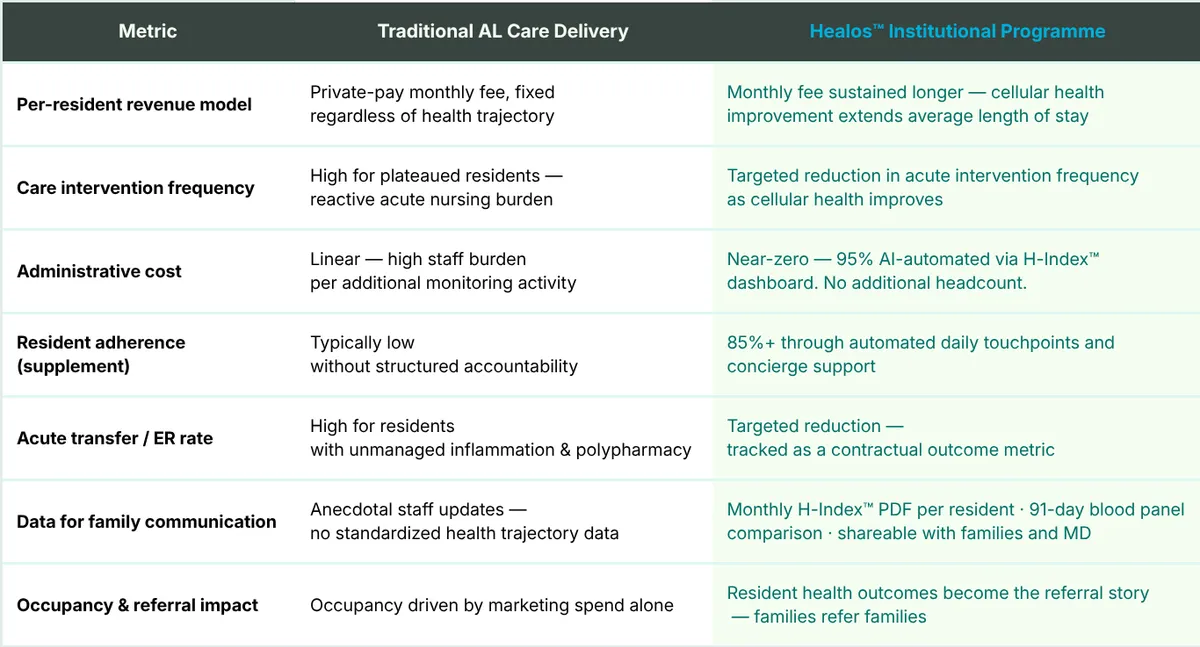
INSTITUTIONAL ECONOMICS
The economics of the Healos™ institutional model
How the Healos™ Sovereign Node partnership changes the economics of long-term care delivery
— for institutions that integrate it as a structured resident health programme.
Institutional partnership enquiries: Healos™ is building a network of private senior living partners across Florida and New York. The 20-resident Trial is the entry point — the long-term programme (full community, 80–150+ residents) is what the partnership becomes. Nutritional formulations are dietary supplements compliant with the FDA DSHEA framework · Pharmacist-reviewed against resident medication profiles · No prescription required · NPN application in progress with Health Canada for Canadian institutional partners.
Contact us directly for a proposal specific to your community's size, resident population, and current care metrics.
Healos™ Patient Programmes
"I Thought I Was Fixed": Slipping Back After a Heart Attack | Healos™
"I Thought I Was Fixed": Why Heart Patients Slip Back Six to 18 Months Later
In the first weeks after a heart attack or stent, motivation is high. The pills are lined up, the walks are daily, the salt shaker disappears. Then, somewhere between six and 18 months, life fills back in. You feel well. A prescription lapses, the walks get shorter, an old habit returns. Nobody decides to stop; it just drifts.
Here is the short answer. Many people feel fixed a few months after a heart attack or stent, and medicines, exercise and diet quietly slip. In a 27-country survey of coronary patients at least six months after their event, 71% were above the LDL target, 42% above the blood pressure target and 66% weren't active enough. The risk hasn't gone: about 18% have another major event within a year. Structure and regular check-ins keep protection going.
简短的答案: 心梗或放支架后的头几周,动力很足:药摆得整整齐齐,每天散步,盐瓶也收起来了。然后在 6 到 18 个月之间,生活重新填满:你感觉很好,处方断了,散步越来越短,老习惯回来了。没有人决定放弃,只是慢慢漂走了。
很多人在心梗或放支架几个月后觉得自己「好了」,药物、运动和饮食就悄悄松懈;一项 27 国调查中,事件发生至少六个月后,71% 的冠心病患者 LDL 未达标、42% 血压未达标、66% 活动量不够;风险并没有消失,约 18% 的人一年内再发主要事件;结构和定期跟进,能让保护持续下去。
What the data show
The EUROASPIRE V survey examined 8,261 coronary patients in 27 countries at least six months after their heart attack, stent or bypass (Kotseva et al., European Journal of Preventive Cardiology, 2019):
19% smoked, and 55% of those who smoked at the time of their event were still smoking.
38% were obese.
66% were physically active less than 30 minutes five times a week.
42% were above the blood pressure target and 71% above the LDL target of 1.8 mmol/L.
Medicines drift too. In Ontario, only about 40% of older adults were still taking a statin two years after an acute coronary syndrome (Jackevicius et al., JAMA, 2002; see statins for life). Meanwhile, about 18% of heart attack survivors have another major cardiovascular event within the first year (Jernberg et al., European Heart Journal, 2015).
数据怎么说: EUROASPIRE V 调查了 27 个国家的 8,261 名冠心病患者,时间是心梗、支架或搭桥后至少六个月(Eur J Prev Cardiol 2019):19% 仍在吸烟,事件发生时吸烟的人中 55% 还在吸;38% 肥胖;66% 每周达不到 5 次、每次 30 分钟的活动;42% 血压未达标,71% LDL 未达到 1.8 mmol/L 的目标。药物也会漂移:在安大略,急性冠脉综合征两年后只有约 40% 的老年人仍在服用他汀(JAMA 2002)。与此同时,约 18% 的心梗幸存者在第一年内再次发生主要心血管事件(Eur Heart J 2015)。
Why the slip happens
Feeling well is convincing. Once symptoms are gone, medicines feel optional; but they work precisely because they prevent what you can't feel.
The structure ends. Cardiac rehab finishes, appointments space out, and nobody is checking in (see after cardiac rehab ends).
Life returns. Work, family and travel crowd out the routines that recovery depended on.
Side effects or costs go unreported and lead to quiet stopping.
Mood dips after the initial relief can sap motivation.
None of this is a character flaw. It's what happens when the support around a new habit falls away before the habit is fully automatic.
为什么会松懈: 感觉良好很有说服力:症状一消失,药物就显得可有可无,但它们起作用恰恰是因为预防了你感觉不到的事。结构结束了:心脏康复结束,复诊间隔拉长,没有人再来跟进。生活回来了:工作、家庭和旅行挤掉了康复所依赖的作息。副作用或费用没有被说出来,于是悄悄停药。最初的轻松过后,情绪下滑也会消耗动力。这些都不是性格缺陷,而是当一个新习惯还没完全自动化、周围的支持就撤走时,必然会发生的事。
How to keep protection going
Never stop a heart medicine on your own. If it causes side effects or costs too much, tell your doctor or pharmacist; there's almost always an alternative.
Set a yearly check of your numbers: LDL, blood pressure, HbA1c and weight, against your targets.
Make movement a fixed appointment: the same time, most days, ideally with someone.
Use simple tools: a weekly pill organiser, automatic refills, phone reminders.
Re-commit after a lapse, rather than giving up: one missed week isn't failure.
Keep a support system: a partner, a walking group or a community such as Second Chapter.
Know the warning signs and call 911 for chest pain, breathlessness or fainting.
如何让保护持续下去: 绝不自行停用心脏药物,有副作用或费用太高,告诉医生或药剂师,几乎总有替代方案;每年对照目标检查一次数字:LDL、血压、HbA1c 和体重;把活动变成固定预约:每天同一时间,最好有人一起;使用简单工具:每周分格药盒、自动续药、手机提醒;松懈后重新开始,而不是放弃,错过一周不是失败;保持支持系统:伴侣、步行小组或 Second Chapter 这样的社群;了解警示信号,胸痛、气短或晕厥拨打 911。
How Healos™ supports the long haul
Healos™ is built for exactly this stretch, when the structure of acute care has ended but the risk hasn't. Sovereign Monthly · Recovery provides ongoing complementary nutrition matched to your medication list and pharmacist-reviewed before it ships, with regular check-ins that keep your numbers, medicines and habits in view, so drift is noticed early and reaches your doctor. If you're within the first months after an event, the 91-Day Protocol gives that period structure first. Both run alongside your medicines, never instead.
Healos™ 如何支持长期坚持: Healos™ 正是为这段时期而建:急性期的结构已经结束,风险却还在。Sovereign Monthly · Recovery 提供持续的辅助营养,与用药清单匹配、发货前经药剂师审核,并定期跟进,让你的数字、药物和习惯始终可见,松懈能被及早发现并传达给医生。如果你还在事件后的头几个月,91 天方案先为这段时间提供结构。两者都与药物并行,绝不替代。
The bottom line
Feeling fixed is good news, but it isn't the same as being protected. Six to 18 months after a heart attack or stent, medicines, movement and diet often drift, while the risk of another event remains real. Keep taking your medicines, check your numbers yearly, make activity a fixed appointment and build a support system that notices when things slip.
结论: 感觉「好了」是好消息,但不等于已经受到保护。心梗或放支架后 6 到 18 个月,药物、活动和饮食常常松懈,而再次发作的风险依然真实存在。坚持服药,每年检查数字,把活动变成固定预约,建立一个能在松懈时提醒你的支持系统。
Frequently asked questions
Why do people stop taking their heart medication? Usually not by decision: feeling well, side effects, costs, lapsed prescriptions and the end of structured follow-up all contribute. In Ontario, only about 40% of older adults were still on a statin two years after a heart event.
I feel fine after my stent. Do I still need my pills? Yes. Medicines such as statins and antiplatelets protect against events you can't feel coming. Never stop on your own; talk to your doctor about side effects or costs.
What is my risk of another heart attack? It varies, but about 18% of heart attack survivors have another major cardiovascular event within the first year, and risk remains raised afterwards, which is why ongoing prevention matters.
How do I stay motivated after a heart attack? Build structure rather than relying on willpower: fixed times for activity, a pill organiser and reminders, yearly checks of your numbers and people who keep you accountable.
常见问题:
为什么人们会停用心脏药?通常不是刻意决定,而是感觉好了、副作用、费用、处方断了和随访结束共同导致,安大略两年后只有约 40% 仍服他汀。
支架后感觉好了,还要吃药吗?要,他汀和抗血小板药预防你感觉不到的事件,不要自行停药,有副作用或费用问题找医生。
再次心梗风险有多大?约 18% 的心梗幸存者一年内再发主要事件,之后风险仍偏高。
怎么保持动力?靠结构而不是意志力:固定活动时间、药盒和提醒、每年查数字、有人督促。
References
Kotseva K, et al. Lifestyle and impact on cardiovascular risk factor control in coronary patients across 27 countries: results from the ESC-EORP EUROASPIRE V registry. European Journal of Preventive Cardiology. 2019;26(8):824–835.
Jackevicius CA, Mamdani M, Tu JV. Adherence with statin therapy in elderly patients with and without acute coronary syndromes. JAMA. 2002;288(4):462–467.
Jernberg T, et al. Cardiovascular risk in post-myocardial infarction patients: nationwide real world data demonstrate the importance of a long-term perspective. European Heart Journal. 2015;36(19):1163–1170.
Healos™ Canada — Integrative cellular recovery for post-cardiac, post-stroke, and ACHD patients.
Canada.USA.Mexico.Japan.China.Singapore.Australia...
SMS & voicemail: 365.909.2567
Ottawa, Ontario, Canada
PATIENT SERVICES


© 2026 Healos™ Canada · NoHeartAttack.com · Ottawa, Ontario Privacy - Terms - Refunds
Healos™ programmes are dietary supplements and integrative wellness services. They are not medical advice, not medical treatment, and not a substitute for professional medical care.
Always consult your physician, cardiologist, or pharmacist before starting any new supplement programme. In case of cardiac emergency, call 911 immediately. Healos™ Canada