FOR LTC & SENIOR CARE INSTITUTIONS · B2B PROGRAMME
Your waiting list is
1,000 people long.
Your beds won't open
until patients improve.
The LTC capacity crisis is not a bed problem. It is a patient turnover problem. When existing residents plateau on inflammation markers, can't meet discharge thresholds, and transfer to hospital at high rates — no number of new beds fixes the waiting list. Healos™ addresses the cellular health of your highest-risk residents, so the beds can move.
1000+
Waiting list per
typical 100-bed
LTC institution
5–7yr
Average Ontario
wait time
(was 2–3 years)
20
High-risk patients
in the Healos™
Trial proposal
100+
Patients per
institution
at contract stage
| ~68% of cardiac residents | On statins — CoQ10 depleted 40–50%. Fatigue prevents rehab completion. |
| ~52% on loop diuretics | K · Mg · Thiamine depleted. Electrolyte-driven arrhythmia and weakness. |
| 40–50% of cardiac patients | Clinical fear of recurrence. Untracked. Multiplies all other risk (×0.4). |
| Complex polypharmacy | 3–6 concurrent medications typical. Drug-nutrient conflicts compound. |
| No GP access (6.5M Canadians) | Residents waiting for LTC often have no regular physician to intercept decline. |
| Healos™ Trial: 20 patients | Targets all five mechanisms simultaneously. 3-month measurable outcome. |
🛡 All protocols pharmacist-reviewed against complex polypharmacy regimens 📋 Monthly H-Index report for every enrolled resident — shareable with clinical team
🔒 HIPAA & PIPEDA · Private Firestore Vault per resident 📊 Contractual inflammation targets — measurable, verifiable outcomes
THE STRUCTURAL CRISIS - THE NUMBERS
The Waiting List Won't Shorten
Until Your Current Residents Get Better.
These are the structural conditions driving the LTC capacity crisis. Healos™ is designed specifically for this gap
— not as wellness, but as a measurable cellular health intervention for your highest-risk residents.
1,000+
Waiting list per 100-bed LTC institution in many Ontario regions
5–7yr
Current average Ontario LTC wait time — up from 2–3 years
6.5 M
Canadians without a registered family physician (2024)
40 - 50%
CoQ10 depletion in statin patients — the primary energy deficit driving care burden
The mechanism: When LTC residents have unaddressed drug-nutrient depletions, subclinical chronic inflammation, and mitochondrial energy deficits — they do not meet discharge criteria, they transfer to hospital at higher rates, and they require more intensive nursing intervention per day. Each of these outcomes directly lengthens your waiting list and increases your per-resident care cost. Healos™ addresses all three mechanisms simultaneously in a structured, pharmacist-reviewed, monthly-tracked program.
THE HEALOS™ LTC TRIAL PROPOSAL
20 high-risk residents. 3 months.
Measurable outcomes before you commit to anything larger.
The Trial is structured to protect your institution. You select the patients. You set the
outcome expectations. We deliver the data. The long-term contract is conditional on
hitting the agreed targets.
The 20-Patient · 3-Month · LTC Trial
Structured to demonstrate measurable outcome before full institutional commitment
WHAT THE TRIAL MEANS FOR EACH DECISION-MAKER
CEO / EXECUTIVE DIRECTOR
ROI & competitive positioning
- Measurable reduction in per-resident nursing intervention frequency
- Inflammation marker improvement documented in clinical record
- First LTC institution in region offering structured cellular health — market differentiation
- Data package for regulatory and board reporting on care quality
DIRECTOR OF CARE (DOC)
Clinical outcomes & care burden
- Monthly H-Index report per resident — clinical picture between physician visits
- hs-CRP and CoQ10 blood panel before/after comparison at Day 91
- Drug-nutrient interaction review flagging unaddressed polypharmacy gaps
- AI-automated daily tracking — near-zero additional nursing workload
DIRECTOR OF FINANCE (DOF)
Cost analysis & contract terms
- Trial cost per resident: substantially below one acute-care transfer event
- Long-term contract pricing: per-resident monthly fee, volume-discounted at 100+ patients
- Administrative cost: near-zero due to AI automation (no additional headcount)
- Contract conditional on agreed inflammation and care-intensity targets being met
We will respond personally within 48 hours · Proposal includes full pricing, target metrics, and contract terms
INSTITUTIONAL ECONOMICS
The economics of the Healos™ institutional model
How the Healos™ Sovereign Node partnership changes the economics of long-term care delivery
— for institutions that integrate it as a structured resident health programme.
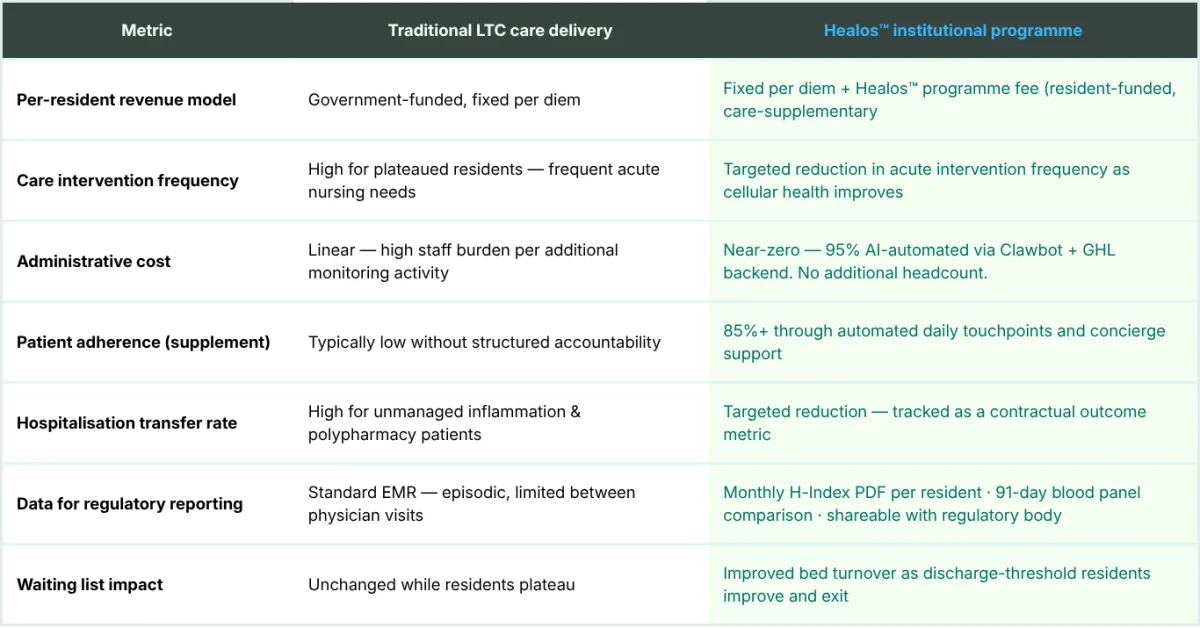
Institutional partnership enquiries: Healos™ is building a network of institutional LTC partners across Ontario and Canada. The Trial is the entry point — the long-term contract (average 100+ residents per institution) is what the partnership becomes. Contact us directly for a proposal specific to your institution's size, patient population, and current care metrics.
Healos™ Patient Programmes
5 Drug-Nutrient Interactions in Post-Cardiac Care | Healos™ PharmD Reference
Five Drug-Nutrient Interactions Every Post-Cardiac Pharmacist Sees
Post-cardiac patients arrive at the pharmacy counter with two lists. One is printed by the hospital. The other lives in a shopping bag: fish oil from the warehouse store, a magnesium that a friend swears by, a turmeric capsule seen online, a salt substitute bought after the cardiologist said "less salt".
Pharmacists are often the only professionals who see both lists together.
The short answer: five drug-nutrient interactions dominate post-cardiac pharmacy practice: statins lowering coenzyme Q10; diuretics depleting magnesium and potassium; long-term PPIs lowering magnesium and vitamin B12; warfarin interacting with vitamin K intake and supplements such as St John's wort; and antiplatelet or anticoagulant therapy adding to bleeding risk from supplements like high-dose fish oil, vitamin E and ginkgo.
简短的答案: 心脏术后患者来到药房柜台时带着两份清单:一份是医院打印的,另一份在购物袋里——仓储超市买的鱼油、朋友推荐的镁、网上看到的姜黄胶囊、医生说「少吃盐」后买的代盐。药剂师往往是唯一同时看到两份清单的专业人员。最常见的五种相互作用:他汀降低辅酶 Q10;利尿剂消耗镁和钾;长期 PPI 降低镁和 B12;华法林与维生素 K 摄入及贯叶连翘等补充剂相互作用;抗血小板或抗凝治疗叠加高剂量鱼油、维生素 E、银杏等补充剂的出血风险。
1. Statins and coenzyme Q10
The interaction. Statins inhibit the mevalonate pathway that also produces coenzyme Q10. High-dose atorvastatin lowered blood CoQ10 by about half within 30 days (Rundek et al., Archives of Neurology, 2004).
What you'll hear. "My legs ache since the new pill." "I'm tired all the time." Muscle complaints are one of the most common reasons patients stop statins on their own.
What to say. Evidence that CoQ10 relieves statin-associated muscle symptoms is mixed, with meta-analyses pointing in different directions. The key counselling point is not the supplement; it's keeping the patient on a statin while the prescriber considers options such as a different agent, dose or schedule. CoQ10 can be a reasonable low-risk addition to discuss, and it does not interact meaningfully with statins themselves.
一、他汀与辅酶 Q10: 相互作用:他汀抑制同时生成辅酶 Q10 的甲羟戊酸通路,高剂量阿托伐他汀 30 天内使血液 CoQ10 降低约一半。常听到:「换了新药后腿酸」「总是很累」——肌肉不适是患者自行停用他汀的最常见原因之一。怎么说:CoQ10 缓解他汀相关肌肉症状的证据不一,咨询重点不是补充剂,而是让患者在处方医生考虑换药、调整剂量或服药时间期间继续服用他汀;CoQ10 可作为值得讨论的低风险补充,本身与他汀无明显相互作用。
2. Loop and thiazide diuretics with magnesium and potassium
The interaction. Diuretics increase urinary losses of magnesium and potassium. Low magnesium makes hypokalaemia harder to correct and is associated with arrhythmias, an important consideration in patients also taking QT-prolonging drugs. Thiazides also reduce calcium excretion, which matters for patients taking calcium and vitamin D.
What you'll hear. Night cramps, palpitations, "my potassium keeps coming back low".
What to say. Encourage magnesium to be checked alongside potassium, and flag persistent hypokalaemia to the prescriber. If a patient wants to self-supplement magnesium, check kidney function first; magnesium accumulates when kidney function is reduced. Separate magnesium from interacting drugs such as some antibiotics and levothyroxine.
二、袢利尿剂/噻嗪类与镁和钾: 相互作用:利尿剂增加镁钾经尿流失;低镁让低钾更难纠正,并与心律失常相关,对同时服用延长 QT 药物者尤为重要;噻嗪类还减少钙排出,与钙和维生素 D 同服时需注意。常听到:夜间抽筋、心悸、「我的钾总是偏低」。怎么说:建议测钾时同时测镁,持续低钾告知处方医生;患者想自行补镁时先确认肾功能(肾功能下降时镁会蓄积),并与部分抗生素、左甲状腺素等有相互作用的药物错开服用。
3. Proton pump inhibitors with magnesium and vitamin B12
The interaction. PPIs are routinely co-prescribed for gastrointestinal protection during dual antiplatelet therapy. Long-term use, generally over a year, can cause hypomagnesaemia (FDA Drug Safety Communication, 2011), and two or more years of use was associated with 65% higher odds of vitamin B12 deficiency (Lam et al., JAMA, 2013). Metformin compounds the B12 effect.
The drug-drug footnote. For patients on clopidogrel, omeprazole and esomeprazole inhibit CYP2C19, which activates clopidogrel; pantoprazole is generally preferred.
What to say. Ask whether the PPI is still needed once DAPT has been stepped down. Suggest B12 testing for long-term PPI users, especially those also taking metformin or reporting numbness, memory changes or fatigue.
三、质子泵抑制剂与镁和 B12: 相互作用:DAPT 期间常规联用 PPI 保护胃肠道。长期(通常超过一年)使用可致低镁血症(FDA 2011),两年以上与 B12 缺乏几率高 65% 相关(JAMA 2013),二甲双胍会叠加 B12 影响。药物相互作用附注:服用氯吡格雷时,奥美拉唑和埃索美拉唑抑制激活氯吡格雷的 CYP2C19,一般优先泮托拉唑。
怎么说:DAPT 降阶后询问 PPI 是否仍需要;建议长期 PPI 使用者检测 B12,尤其同时服用二甲双胍或有麻木、记忆变化、疲劳者。
4. Warfarin with vitamin K and supplements
The interaction. Warfarin works by antagonising vitamin K, so large swings in dietary vitamin K move the INR. The goal is consistency, not avoidance: patients don't need to give up leafy greens, but they should eat similar amounts week to week.
Supplements to watch. St John's wort induces CYP enzymes and P-glycoprotein and can lower warfarin levels; it also interacts with DOACs, clopidogrel, ticagrelor and statins, and is best avoided in post-cardiac patients. Coenzyme Q10 is structurally related to vitamin K, and case reports have described reduced INR, although a randomised crossover trial found no significant INR change at 100 mg/day (Engelsen et al., Thrombosis and Haemostasis, 2002). Multivitamins containing vitamin K, green tea extracts and high-dose vitamin E are also worth asking about.
What to say. Any new supplement, or any change in diet, is a reason to check the INR sooner. Most DOACs have fewer food interactions, but strong CYP3A4 and P-gp inducers such as St John's wort still matter.
四、华法林与维生素 K 及补充剂: 相互作用:华法林通过拮抗维生素 K 起效,饮食中维生素 K 大幅波动会改变 INR;目标是稳定而非回避,患者不必放弃绿叶蔬菜,但每周摄入量应相近。需要留意的补充剂:贯叶连翘诱导 CYP 酶和 P-gp,可降低华法林水平,也与 DOAC、氯吡格雷、替格瑞洛和他汀相互作用,心脏术后患者最好避免;辅酶 Q10 结构与维生素 K 相似,有病例报告 INR 下降,但随机交叉试验中每日 100 mg 未显著改变 INR;含维生素 K 的复合维生素、绿茶提取物和高剂量维生素 E 也值得询问。
怎么说:任何新补充剂或饮食改变都是提前复查 INR 的理由;多数 DOAC 食物相互作用较少,但贯叶连翘等强 CYP3A4/P-gp 诱导剂仍然重要。
5. Antiplatelets and anticoagulants with bleeding-additive supplements
The interaction. Several popular supplements have mild antiplatelet or anticoagulant effects: high-dose fish oil, vitamin E, ginkgo, garlic extracts and turmeric or curcumin among them. Individually the effect is usually modest. Even the prescription EPA product in REDUCE-IT, at 4 g/day, was associated with only a small increase in serious bleeding, 2.7% versus 2.1% (Bhatt et al., NEJM, 2019). But post-cardiac patients are often on two or three antithrombotic agents, and supplement effects stack.
What you'll hear. "It's natural, so it's safe." "I've taken it for years." Easy bruising, nosebleeds or bleeding gums are often mentioned in passing.
What to say. Ask directly about supplements at every antithrombotic fill, record them in the profile, and make sure the prescriber knows. For fish oil, the practical questions are dose and indication; for ginkgo and vitamin E, the benefit rarely justifies the added risk in this population.
五、抗血小板/抗凝药与叠加出血风险的补充剂: 相互作用:多种流行补充剂有轻度抗血小板或抗凝作用,包括高剂量鱼油、维生素 E、银杏、大蒜提取物、姜黄/姜黄素。单独影响通常不大,即使 REDUCE-IT 中每日 4 克处方 EPA,严重出血也仅略增(2.7% vs 2.1%);但心脏术后患者常同时服用两三种抗栓药,补充剂的作用会叠加。
常听到:「天然的就安全」「吃了好多年」,容易瘀青、流鼻血、牙龈出血常被顺口提及。
怎么说:每次配抗栓药时直接询问补充剂,记入档案并确保处方医生知情;鱼油关键在剂量和用途;银杏和维生素 E 在这一人群中的获益很少能抵消额外风险。
Bonus: the salt substitute nobody mentions
Patients told to cut salt often switch to potassium-based salt substitutes. At a population level these can be beneficial: in the SSaSS trial, a potassium-enriched salt substitute reduced stroke. But that trial excluded people taking potassium-sparing drugs and those with serious kidney disease (Neal et al., NEJM, 2021), which describes a large share of post-cardiac patients on ACE inhibitors, ARBs, spironolactone or eplerenone. For those patients, a salt substitute is a potassium supplement in disguise, and it belongs in the interaction check.
附加:没人提起的代盐: 被要求少盐的患者常改用含钾代盐。从人群层面看可能有益:SSaSS 试验中富钾代盐减少了卒中,但该试验排除了服用保钾药物和严重肾病者(NEJM 2021),而这恰恰描述了大量服用 ACEI、ARB、螺内酯或依普利酮的心脏术后患者。对他们来说,代盐就是伪装的钾补充剂,应纳入相互作用检查。
How Healos™ works with pharmacists
Healos™ treats the medication list as the first input for every patient, not an afterthought. Before any nutritional programme begins, the patient's prescriptions and existing supplements are reviewed for the interactions described here, and anything that needs a professional decision is routed back to the patient's pharmacist or prescriber. Healos™ products are Health Canada NPN-licensed, labelled within their authorised claims and positioned as complementary support (see NPN compliance for cardiovascular supplements).
For pharmacists, that means patients who arrive with a complete, structured supplement list, and a partner who expects you to have the final word on interactions.
Healos™ 如何与药剂师合作: Healos™ 把用药清单作为每位患者的第一输入,而不是事后补充:任何营养方案开始前,都会就本文所述的相互作用审查患者的处方和现有补充剂,任何需要专业判断的事项都转回患者的药剂师或处方医生。Healos™ 产品获 Health Canada NPN 许可,标签在授权声明范围内,定位为辅助支持。对药剂师来说,这意味着患者会带着完整、结构化的补充剂清单来到柜台,以及一个期待由您对相互作用做最终判断的合作伙伴。
The bottom line
The most dangerous interaction is the one nobody asks about. Five predictable patterns cover most of what post-cardiac patients bring to the counter, and a short set of routine questions at every fill turns the shopping-bag list into part of the medication record.
结论: 最危险的相互作用,是没人问起的那一个。五种可预测的模式涵盖了心脏术后患者带到柜台的大部分情况;每次配药时几个常规问题,就能把购物袋里的清单变成用药记录的一部分。
Frequently asked questions
Which supplements interact with heart medications? The most common concerns are coenzyme Q10 with statins and warfarin, magnesium with diuretics and PPIs, vitamin K and St John's wort with warfarin, and high-dose fish oil, vitamin E, ginkgo, garlic and turmeric with antiplatelet or anticoagulant drugs. Potassium salt substitutes matter for patients on ACE inhibitors, ARBs or aldosterone antagonists.
Can I take fish oil with blood thinners? Often yes, but dose matters and your care team should know. High-dose omega-3 has mild antiplatelet effects; in the REDUCE-IT trial, 4 g/day of prescription EPA slightly increased serious bleeding. Ask your pharmacist or prescriber before starting.
Does CoQ10 affect warfarin? Possibly, in some people. CoQ10 is structurally similar to vitamin K and case reports describe reduced INR, although a randomised trial found no significant change at 100 mg/day. Check your INR sooner after starting or stopping it.
Which supplements increase bleeding risk with aspirin or clopidogrel? High-dose fish oil, vitamin E, ginkgo, garlic extracts and turmeric or curcumin can add to bleeding risk. Their effects are usually modest individually but stack with antiplatelet and anticoagulant therapy.
Can heart patients use potassium salt substitutes? Some can, but patients taking ACE inhibitors, ARBs, spironolactone or eplerenone, or with reduced kidney function, can develop high potassium. Check with a pharmacist or physician first.
常见问题:
哪些补充剂会与心脏药物相互作用?最常见的是 CoQ10 与他汀和华法林、镁与利尿剂和 PPI、维生素 K 和贯叶连翘与华法林,以及高剂量鱼油、维生素 E、银杏、大蒜和姜黄与抗血小板或抗凝药;服用 ACEI、ARB 或醛固酮拮抗剂者还需注意含钾代盐。
服用抗凝药可以吃鱼油吗?常常可以,但剂量重要,需告知医疗团队。
CoQ10 会影响华法林吗?部分人可能会,开始或停用后应提前复查 INR。
哪些补充剂会增加阿司匹林或氯吡格雷的出血风险?高剂量鱼油、维生素 E、银杏、大蒜提取物、姜黄/姜黄素。
心脏病人能用含钾代盐吗?部分可以,但服用 ACEI、ARB、螺内酯或依普利酮或肾功能减退者可能高钾,请先咨询。
References
Rundek T, et al. Atorvastatin decreases the coenzyme Q10 level in the blood of patients at risk for cardiovascular disease and stroke. Archives of Neurology. 2004;61(6):889–892.
US Food and Drug Administration. Drug Safety Communication: Low magnesium levels can be associated with long-term use of proton pump inhibitor drugs (PPIs). 2011.
Lam JR, et al. Proton pump inhibitor and histamine 2 receptor antagonist use and vitamin B12 deficiency. JAMA. 2013;310(22):2435–2442.
Engelsen J, et al. Effect of coenzyme Q10 and Ginkgo biloba on warfarin dosage in stable, long-term warfarin treated outpatients: a randomised, double blind, placebo-crossover trial. Thrombosis and Haemostasis. 2002;87(6):1075–1076.
Holbrook AM, et al. Systematic overview of warfarin and its drug and food interactions. Archives of Internal Medicine. 2005;165(10):1095–1106.
Bhatt DL, et al. Cardiovascular risk reduction with icosapent ethyl for hypertriglyceridemia (REDUCE-IT). New England Journal of Medicine. 2019;380:11–22.
Neal B, et al. Effect of salt substitution on cardiovascular events and death (SSaSS). New England Journal of Medicine. 2021;385:1067–1077.
Healos™ Canada — Integrative cellular recovery for post-cardiac, post-stroke, and ACHD patients.
Canada.USA.Mexico.Japan.China.Singapore.Australia...
SMS & voicemail: 365.909.2567
Ottawa, Ontario, Canada
PATIENT SERVICES


© 2026 Healos™ Canada · NoHeartAttack.com · Ottawa, Ontario Privacy - Terms - Refunds
Healos™ programmes are dietary supplements and integrative wellness services. They are not medical advice, not medical treatment, and not a substitute for professional medical care.
Always consult your physician, cardiologist, or pharmacist before starting any new supplement programme. In case of cardiac emergency, call 911 immediately. Healos™ Canada