FOR LTC & SENIOR CARE INSTITUTIONS · B2B PROGRAMME
Your waiting list is
1,000 people long.
Your beds won't open
until patients improve.
The LTC capacity crisis is not a bed problem. It is a patient turnover problem. When existing residents plateau on inflammation markers, can't meet discharge thresholds, and transfer to hospital at high rates — no number of new beds fixes the waiting list. Healos™ addresses the cellular health of your highest-risk residents, so the beds can move.
1000+
Waiting list per
typical 100-bed
LTC institution
5–7yr
Average Ontario
wait time
(was 2–3 years)
20
High-risk patients
in the Healos™
Trial proposal
100+
Patients per
institution
at contract stage
| ~68% of cardiac residents | On statins — CoQ10 depleted 40–50%. Fatigue prevents rehab completion. |
| ~52% on loop diuretics | K · Mg · Thiamine depleted. Electrolyte-driven arrhythmia and weakness. |
| 40–50% of cardiac patients | Clinical fear of recurrence. Untracked. Multiplies all other risk (×0.4). |
| Complex polypharmacy | 3–6 concurrent medications typical. Drug-nutrient conflicts compound. |
| No GP access (6.5M Canadians) | Residents waiting for LTC often have no regular physician to intercept decline. |
| Healos™ Trial: 20 patients | Targets all five mechanisms simultaneously. 3-month measurable outcome. |
🛡 All protocols pharmacist-reviewed against complex polypharmacy regimens 📋 Monthly H-Index report for every enrolled resident — shareable with clinical team
🔒 HIPAA & PIPEDA · Private Firestore Vault per resident 📊 Contractual inflammation targets — measurable, verifiable outcomes
THE STRUCTURAL CRISIS - THE NUMBERS
The Waiting List Won't Shorten
Until Your Current Residents Get Better.
These are the structural conditions driving the LTC capacity crisis. Healos™ is designed specifically for this gap
— not as wellness, but as a measurable cellular health intervention for your highest-risk residents.
1,000+
Waiting list per 100-bed LTC institution in many Ontario regions
5–7yr
Current average Ontario LTC wait time — up from 2–3 years
6.5 M
Canadians without a registered family physician (2024)
40 - 50%
CoQ10 depletion in statin patients — the primary energy deficit driving care burden
The mechanism: When LTC residents have unaddressed drug-nutrient depletions, subclinical chronic inflammation, and mitochondrial energy deficits — they do not meet discharge criteria, they transfer to hospital at higher rates, and they require more intensive nursing intervention per day. Each of these outcomes directly lengthens your waiting list and increases your per-resident care cost. Healos™ addresses all three mechanisms simultaneously in a structured, pharmacist-reviewed, monthly-tracked program.
THE HEALOS™ LTC TRIAL PROPOSAL
20 high-risk residents. 3 months.
Measurable outcomes before you commit to anything larger.
The Trial is structured to protect your institution. You select the patients. You set the
outcome expectations. We deliver the data. The long-term contract is conditional on
hitting the agreed targets.
The 20-Patient · 3-Month · LTC Trial
Structured to demonstrate measurable outcome before full institutional commitment
WHAT THE TRIAL MEANS FOR EACH DECISION-MAKER
CEO / EXECUTIVE DIRECTOR
ROI & competitive positioning
- Measurable reduction in per-resident nursing intervention frequency
- Inflammation marker improvement documented in clinical record
- First LTC institution in region offering structured cellular health — market differentiation
- Data package for regulatory and board reporting on care quality
DIRECTOR OF CARE (DOC)
Clinical outcomes & care burden
- Monthly H-Index report per resident — clinical picture between physician visits
- hs-CRP and CoQ10 blood panel before/after comparison at Day 91
- Drug-nutrient interaction review flagging unaddressed polypharmacy gaps
- AI-automated daily tracking — near-zero additional nursing workload
DIRECTOR OF FINANCE (DOF)
Cost analysis & contract terms
- Trial cost per resident: substantially below one acute-care transfer event
- Long-term contract pricing: per-resident monthly fee, volume-discounted at 100+ patients
- Administrative cost: near-zero due to AI automation (no additional headcount)
- Contract conditional on agreed inflammation and care-intensity targets being met
We will respond personally within 48 hours · Proposal includes full pricing, target metrics, and contract terms
INSTITUTIONAL ECONOMICS
The economics of the Healos™ institutional model
How the Healos™ Sovereign Node partnership changes the economics of long-term care delivery
— for institutions that integrate it as a structured resident health programme.
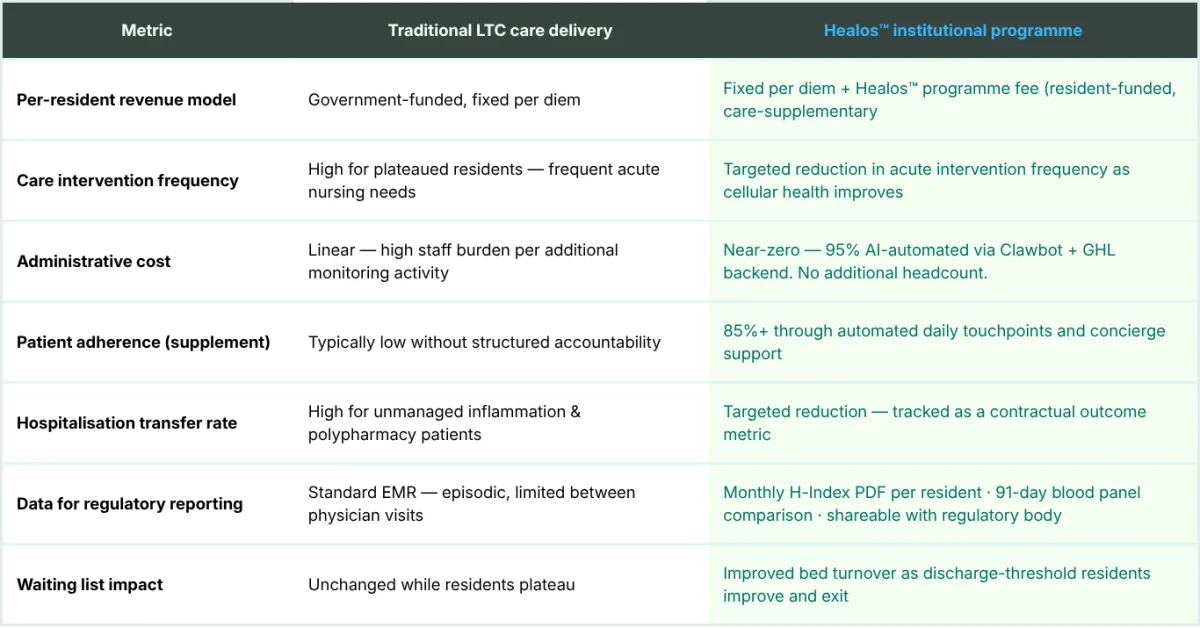
Institutional partnership enquiries: Healos™ is building a network of institutional LTC partners across Ontario and Canada. The Trial is the entry point — the long-term contract (average 100+ residents per institution) is what the partnership becomes. Contact us directly for a proposal specific to your institution's size, patient population, and current care metrics.
Healos™ Patient Programmes
Warning Signs Before Sudden Cardiac Arrest | Healos™
Warning Signs Before Sudden Cardiac Arrest: What the Weeks Before Can Tell You
When someone collapses from a sudden cardiac arrest, the people around them almost always say the same thing: "There was no warning." Often, that isn't quite true. The warning came days or weeks earlier, and it was explained away.
Here is the short answer. Sudden cardiac arrest often isn't as sudden as it seems. In one community study, about half of people who had an arrest had warning symptoms, most often chest pain or breathlessness, in the four weeks before, yet few called 911. Recognising those signs, getting checked early and knowing CPR and where the nearest AED is can make the difference between dying and surviving.
简短的答案: 当有人因心脏骤停倒下时,身边的人几乎总会说同一句话:「完全没有预兆。」但事实往往并非如此:预警早在几天或几周前就出现了,只是被解释掉了。
心脏骤停往往并不像看起来那么突然:一项社区研究中,约一半发生心脏骤停的人之前四周内有过警示症状,最常见的是胸痛或气短,但很少有人拨打 911。识别这些信号、尽早检查、学会心肺复苏并知道最近的 AED 在哪里,可能决定生死。
Heart attack vs cardiac arrest: not the same thing
A heart attack is a plumbing problem: a blocked artery starves part of the heart muscle of blood. The person is usually awake, often with chest pain, and needs 911 urgently.
A cardiac arrest is an electrical problem: the heart's rhythm suddenly becomes chaotic, usually ventricular fibrillation, and it stops pumping. The person collapses, isn't breathing normally and dies within minutes without CPR and a shock from a defibrillator.
A heart attack can trigger a cardiac arrest, which is one reason heart attack symptoms always deserve an emergency call.
心梗和心脏骤停不是一回事:
心梗是「水管」问题:动脉堵塞,部分心肌缺血;患者通常清醒,常有胸痛,需要立即拨打 911。
心脏骤停是「电路」问题:心律突然紊乱(通常是室颤),心脏停止泵血;患者倒下、没有正常呼吸,没有心肺复苏和除颤器电击,几分钟内就会死亡。
心梗可能诱发心脏骤停,这也是心梗症状永远值得拨打急救电话的原因之一。
The warning signs people explain away
In the Oregon Sudden Unexpected Death Study, about half of people aged 35 to 65 who had a sudden cardiac arrest had warning symptoms in the four weeks before (Marijon et al., Annals of Internal Medicine, 2016). The most common were:
Chest pain or pressure, especially in men, often blamed on indigestion or a pulled muscle.
Shortness of breath, especially in women, often blamed on being unfit or tired.
Palpitations, a racing or pounding heart, sometimes with dizziness.
Fainting or near-fainting, particularly during exercise.
Unusual fatigue over days or weeks.
Crucially, few people acted on them. In the same study, survival was about 32% among those who called emergency services about their symptoms beforehand, compared with about 6% among those who didn't.
被人们解释掉的警示信号: 俄勒冈猝死研究中,35–65 岁发生心脏骤停的人约一半在之前四周内有过警示症状(Ann Intern Med 2016),最常见的有:
胸痛或胸闷——男性多见,常被当成消化不良或肌肉拉伤;
气短——女性多见,常被当成体力差或累了;
心悸——心跳加快或重重地跳,有时伴头晕;晕厥或近乎晕厥,尤其在运动时;持续数天或数周的异常疲劳。
关键在于很少有人据此行动:同一研究中,事先就症状拨打急救电话的人存活率约 32%,没有拨打的人约 6%。
Who is at higher risk
Previous heart attack, especially with reduced pumping function (a low ejection fraction).
Heart failure or cardiomyopathy.
Coronary artery disease risk factors: high blood pressure, high cholesterol, diabetes, smoking, especially after 50.
A family history of sudden death before 50, or of inherited heart conditions.
Congenital heart disease and some rhythm disorders.
Overwork, poor sleep and chronic stress, which raise risk over time (see overwork and the heart).
Modern medicine is at its best when it comes to finding problems and saving lives in an emergency. But most heart disease risk builds quietly over the ten or twenty years before the first symptom. That window depends on timely screening, healthy habits kept up over time, and the right preventive care.
谁的风险更高:
曾经心梗,尤其泵血功能下降(射血分数低);心衰或心肌病;
冠心病危险因素:高血压、高胆固醇、糖尿病、吸烟,尤其 50 岁以后;
家族中有人 50 岁前猝死或有遗传性心脏病;
先天性心脏病和部分心律失常;过劳、睡眠差和长期压力会随时间增加风险。
现代医学最擅长的是发现问题和抢救;而心脏病的大部分风险,是在症状出现前的十几、二十年里一点点积累的。那段时间,靠的是及时筛查、坚持优良生活方式,和适当的保健预防。
What to do: before, and in the moment
If you have warning symptoms: don't wait for them to pass. Chest pain, unusual breathlessness, palpitations with dizziness or fainting mean call 911; new or recurring milder symptoms mean see your doctor promptly.
If someone collapses and isn't breathing normally:
Call 911 and ask someone to fetch the nearest AED.
Start hands-only CPR: push hard and fast in the centre of the chest, about 100 to 120 times a minute.
Use the AED as soon as it arrives; it talks you through every step.
Bystander CPR can double or triple the chance of survival (American Heart Association). An estimated 35,000 out-of-hospital cardiac arrests happen in Canada each year (Heart and Stroke Foundation of Canada). A short CPR course is one of the most useful things a family can do together.
该怎么做:事前,以及当下: 如果你有警示症状:不要等它过去——胸痛、异常气短、心悸伴头晕或晕厥,请拨打 911;新出现或反复的较轻症状,请尽快看医生。如果有人倒下且没有正常呼吸:1. 拨打 911,并请人去取最近的 AED;2. 开始徒手心肺复苏:在胸部正中用力快速按压,每分钟约 100–120 次;3. AED 一到就使用,它会语音指导每一步。旁观者心肺复苏可让存活率提高两到三倍(美国心脏协会);加拿大每年约有 35,000 例院外心脏骤停(加拿大心脏与卒中基金会)。全家一起上一次简短的心肺复苏课,是最有用的事情之一。
How Healos™ supports long-term heart health
Healos™ can't predict or prevent a cardiac arrest, and it never replaces urgent care. What it supports is the long stretch before and after: screening reminders, blood pressure, sleep, stress and the daily foundations that shape risk. Sovereign Monthly · Protect provides personalised maintenance nutrition built around four cellular nutrients, with regular check-ins; after a recent heart attack, the 91-Day Protocol gives the first months structure. Every kit is pharmacist-reviewed against your medication list.
Healos™ 如何支持长期心脏健康: Healos™ 不能预测或预防心脏骤停,也绝不替代急救。它支持的是事前和事后的漫长时间:筛查提醒、血压、睡眠、压力,以及塑造风险的日常基础。Sovereign Monthly · Protect 提供以四种细胞级营养素为核心的个性化维护营养并定期评估;近期心梗后,91 天方案为头几个月提供结构。每份营养包都经药剂师按用药清单审核。
The bottom line
Sudden cardiac arrest is often preceded by warning signs, chest pain, breathlessness, palpitations, fainting, that busy people explain away. Take them seriously, call 911 when they're significant, get checked early, and learn CPR and where the nearest AED is. Acting early is what turns "there was no warning" into "we caught it in time".
结论: 心脏骤停之前常有警示信号——胸痛、气短、心悸、晕厥,而忙碌的人往往把它们解释掉。认真对待,症状明显时拨打 911,尽早检查,学会心肺复苏并知道最近的 AED 在哪里。及早行动,才能把「完全没有预兆」变成「我们及时发现了」。
Frequently asked questions
Are there warning signs before a cardiac arrest? Often, yes. In one study, about half of people aged 35 to 65 who had a sudden cardiac arrest had symptoms such as chest pain or shortness of breath in the four weeks before.
What is the difference between a heart attack and a cardiac arrest? A heart attack is a blocked artery; the person is usually awake with chest pain. A cardiac arrest is an electrical failure; the person collapses and stops breathing normally, and needs CPR and a defibrillator immediately.
What should I do if someone collapses? Call 911, send someone for the nearest AED, start hands-only CPR by pushing hard and fast in the centre of the chest, and use the AED as soon as it arrives.
Can you survive a cardiac arrest? Yes, especially with fast CPR and defibrillation. Bystander CPR can double or triple survival, and in one study survival was about 32% when symptoms had prompted an emergency call beforehand.
常见问题:
心脏骤停前有征兆吗?常常有,一项研究中约一半在之前四周有胸痛或气短等症状。
心梗和心脏骤停有什么区别?心梗是动脉堵塞、人通常清醒有胸痛;心脏骤停是电路故障、人倒下无正常呼吸,需要立即心肺复苏和除颤。
有人倒下怎么办?拨打 911、请人取 AED、在胸部正中用力快速按压、AED 到了立即使用。
心脏骤停能活下来吗?能,尤其及时心肺复苏和除颤,旁观者心肺复苏可使存活率提高两到三倍。
References
Marijon E, et al. Warning symptoms are associated with survival from sudden cardiac arrest. Annals of Internal Medicine. 2016;164(1):23–29.
American Heart Association. CPR facts and stats; Hands-Only CPR.
Heart and Stroke Foundation of Canada. Cardiac arrest: CPR and AED.
Healos™ Canada — Integrative cellular recovery for post-cardiac, post-stroke, and ACHD patients.
Canada.USA.Mexico.Japan.China.Singapore.Australia...
SMS & voicemail: 365.909.2567
Ottawa, Ontario, Canada
PATIENT SERVICES


© 2026 Healos™ Canada · NoHeartAttack.com · Ottawa, Ontario Privacy - Terms - Refunds
Healos™ programmes are dietary supplements and integrative wellness services. They are not medical advice, not medical treatment, and not a substitute for professional medical care.
Always consult your physician, cardiologist, or pharmacist before starting any new supplement programme. In case of cardiac emergency, call 911 immediately. Healos™ Canada