THE STRUCTURAL REALITY & PRIVATE SENIOR LIVING · US
Your residents' families chose you because they expect more than management.
The data says they're watching closely.
Healos™ cellular nutrition program for private Assisted Living & Memory Care · Florida & New York
91
Day Program ·
20
High-risk residents
20
Measurable Outcomes
| ~68% of cardiac residents | On statins — CoQ10 depleted 40–50%. Fatigue prevents rehab completion. |
| ~52% on loop diuretics | K · Mg · Thiamine depleted. Electrolyte-driven arrhythmia and weakness. |
| 40–50% of cardiac patients | Clinical fear of recurrence. Untracked. Multiplies all other risk (×0.4). |
| Complex polypharmacy | 3–6 concurrent medications typical. Drug-nutrient conflicts compound. |
| No GP access (6.5M Canadians) | Residents waiting for LTC often have no regular physician to intercept decline. |
| Healos™ Trial: 20 patients | Targets all five mechanisms simultaneously. 3-month measurable outcome. |
🛡 All protocols pharmacist-reviewed against complex polypharmacy regimens 📋 Monthly H-Index report for every enrolled resident — shareable with clinical team
🔒 HIPAA & PIPEDA · Private Firestore Vault per resident 📊 Contractual inflammation targets — measurable, verifiable outcomes
THE STRUCTURAL CRISIS - THE NUMBERS
The Waiting List Won't Shorten
Until Your Current Residents Get Better.
These are the structural conditions driving the LTC capacity crisis. Healos™ is designed specifically for this gap
— not as wellness, but as a measurable cellular health intervention for your highest-risk residents.
87.9%
· US assisted living occupancy 2026 — revenue lost in the empty 12.1%
22 months
Average resident length of stay — shortened by unmanaged decline
41%
Annual staff turnover rate — driven by reactive, high-intensity care burden
$5,419/mo
Median private-pay monthly fee — at risk when families move loved ones out
The mechanism: When AL and memory care residents have unaddressed drug-nutrient depletions, subclinical inflammation, and mitochondrial energy deficits — they decline faster, generate more acute care transfers, require more intensive staff intervention per shift, and leave sooner. Each of these outcomes directly reduces your revenue, increases your operational cost, and shortens the tenure of the residents your team worked hard to admit.
Healos™ addresses all four mechanisms simultaneously — in a structured, pharmacist-reviewed, monthly-tracked program.
THE HEALOS™ LTC TRIAL PROPOSAL
20 high-risk residents. 3 months.
Measurable outcomes before you commit to anything larger.
The Trial is structured to protect your institution. You select the patients. You set the
outcome expectations. We deliver the data. The long-term contract is conditional on
hitting the agreed targets.
The 20-Patient · 3-Month · LTC Trial
Structured to demonstrate measurable outcome before full institutional commitment
WHAT THE TRIAL MEANS FOR EACH DECISION-MAKER
CEO / EXECUTIVE DIRECTOR
Occupancy, Length of stay & competitive positioning
Every 1-point improvement in resident quality of life adds an average 85 days to length of stay — at $5,419/month, that is $15,000+ in additional revenue per resident
Measurable reduction in per-resident acute care transfer events — the highest single-incident cost in private AL operations
First community in your market offering structured cellular health tracking — a documented differentiator for family decision-makers comparing facilities
91-day outcome data package suitable for family communication, board reporting, and marketing collateral
DIRECTOR OF CARE (DOC)
Resident stability & care team burden
Monthly H-Index™ report per resident — a clinical picture between physician visits, shareable with attending MD
hs-CRP and CoQ10 blood panel before/after comparison at Day 91 — objective inflammation data in the resident record
Drug-nutrient interaction review for residents on 5+ concurrent medications — flags unaddressed polypharmacy gaps before they become acute events
AI-automated daily tracking — near-zero additional nursing workload; no protocol changes required for your floor team
Marketing DIRECTOR (DOM)
Family satisfaction, referral reputation & move-in conversion
J.D. Power 2025 data shows family satisfaction with AL/memory care is driven by dining, resident activities, and visible wellbeing — precisely what cellular health improvement delivers
Documented resident health improvement creates the referral story families actually tell: “She’s stronger than when she moved in”
91-day outcome report gives your sales team a concrete, data-backed answer to the #1 family objection: “Will my parent actually improve here?”
As acuity levels continue to rise in AL and memory care, a proactive outcome-driven model is the competitive separator operators are looking for — Healos™ gives your community that narrative with verifiable data seniorhousingnews
Healos™ nutritional formulations are dietary supplements compliant with FDA DSHEA framework · No prescription required ·
Pharmacist-reviewed against resident medication profiles
TRIAL SEQUENCE
Step 1
Patient Selection
DOC identifies 20 high-risk residents: elevated hs-CRP · multiple cardiac medications · transfer-risk flags · functional plateau
Step 2
H-Index baseline + pharmacist review
32-dimension baseline audit for each resident. Full drug-nutrient interaction screen before any supplement is introduced. Warfarin/anticoagulant patients screened first.
Step 3
3-month protocol + monthly reporting
3-stage cellular protocol delivered. Monthly H-Index PDF per resident for your clinical team. 24/7 AI monitoring. Day-45 mid-point data review.
Step 4
Day-91 outcome report & contract decision
Full before/after blood panel comparison. H-Index 91-day arc. Clinical outcome summary. If targets met — long-term contract for 100+ patients offered.
We will respond personally within 48 hours · Proposal includes full pricing, target metrics, and contract terms
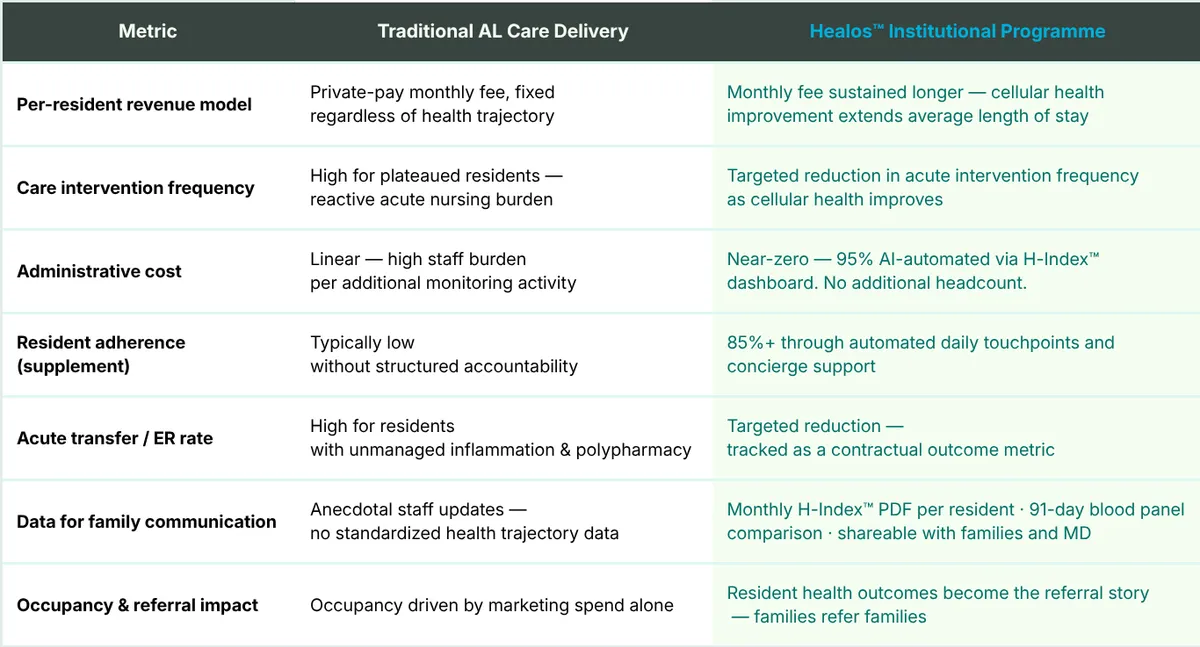
INSTITUTIONAL ECONOMICS
The economics of the Healos™ institutional model
How the Healos™ Sovereign Node partnership changes the economics of long-term care delivery
— for institutions that integrate it as a structured resident health programme.
Institutional partnership enquiries: Healos™ is building a network of private senior living partners across Florida and New York. The 20-resident Trial is the entry point — the long-term programme (full community, 80–150+ residents) is what the partnership becomes. Nutritional formulations are dietary supplements compliant with the FDA DSHEA framework · Pharmacist-reviewed against resident medication profiles · No prescription required · NPN application in progress with Health Canada for Canadian institutional partners.
Contact us directly for a proposal specific to your community's size, resident population, and current care metrics.
Healos™ Patient Programmes
After Cardiac Rehab Ends: What to Do Next | Healos™
After Cardiac Rehab Ends: 36 Sessions Later, Who's Guiding You Now?
For twelve weeks, somebody was watching. A nurse checked your blood pressure before you started. A heart monitor sat on your chest while you walked the treadmill. An exercise physiologist told you when to push and when to ease off. Other people in the room had been through what you'd been through, and on the days you didn't feel like going, you went anyway, because they expected you.
Then came session 36. A certificate, maybe. A handshake. And on Monday morning, nobody was waiting.
Here is the short answer. When cardiac rehab ends, the supervision, schedule and feedback end with it, and many people gradually lose the gains they made. You can exercise safely on your own by using the talk test or a perceived-exertion scale, building toward about 150 minutes of moderate activity a week plus strength work, tracking a few key numbers, and knowing which symptoms mean stop.
The rest of this article shows you how to build your own version of rehab: what cardiologists sometimes call Phase 4, and what most patients simply call "now what?".
简短的答案: 十二周里,一直有人在看着你:护士在你开始前量血压,心电监护贴在胸口,运动生理师告诉你何时加力、何时放缓,身边的人经历过和你一样的事;不想去的日子你也去了,因为他们在等你。然后是第 36 次课,也许有一张证书、一次握手;周一早上,再也没人在等你。
心脏康复结束时,监督、日程和反馈也随之结束,很多人会逐渐失去已取得的进步。你可以安全地自主运动:用说话测试或自觉用力量表控制强度,逐步达到每周约 150 分钟中等强度活动加力量训练,追踪几个关键数字,清楚哪些症状意味着停下。
本文教你搭建属于自己的康复——心脏科医生有时称为「第四阶段」,而多数患者只把它叫作「接下来怎么办」。
What is the "rehab cliff", and why does it happen?
Cardiac rehab works. The 2021 Cochrane review of exercise-based rehabilitation found fewer heart attacks and fewer hospital admissions among people who took part (Dibben et al., 2021). If you finished your sessions, you're already ahead: only about 24% of eligible US Medicare patients participate at all (Ritchey et al., Circulation: Cardiovascular Quality and Outcomes, 2020).
But rehab provides four things that don't come home with you:
Supervision. Someone else was monitoring your heart rate, blood pressure and symptoms. On your own, every twinge feels like a question with no one to answer it.
Structure. Three sessions a week, same time, same place. Now the schedule competes with work, family, weather and the television.
Feedback. You could see your progress: more minutes, higher speed, better numbers. At home, improvement is harder to see, so motivation fades.
Community. The social pull of the group is one of rehab's most underrated ingredients.
When all four disappear at once, activity tends to slide. Not dramatically, and not all at once: three walks a week become two, then weekends only. That gradual decline is the rehab cliff. It doesn't feel like falling. It feels like life getting busy.
什么是「康复悬崖」: 心脏康复有效:2021 年 Cochrane 综述显示参与者心梗和住院更少;而美国符合条件的 Medicare 患者只有约 24% 参加,如果你完成了课程,已经领先。但康复提供的四样东西不会跟你回家:监督(有人监测心率、血压和症状;独自一人时每次不适都像一个没人回答的问题);结构(每周三次、固定时间地点;现在要与工作、家庭、天气和电视竞争);反馈(能看到进步;在家里进步更难看见,动力随之消退);社群(群体的吸引力是康复中最被低估的成分之一)。
四样同时消失,活动量就会下滑——不是一下子,而是每周三次散步变两次,再变成只有周末。这就是康复悬崖:它不像坠落,更像生活变忙了。
How hard should I exercise without a heart monitor?
You don't need a monitor to exercise at the right intensity. Two simple tools, both used in cardiac rehab, work well at home.
The talk test. At a moderate intensity, you should be able to talk in full sentences but not sing. If you can sing, you can go a little harder. If you can only get out a few words at a time, ease off.
The Borg scale. The Rating of Perceived Exertion runs from 6 (no effort) to 20 (maximal effort). Most cardiac rehab programmes aim for about 11 to 14: "fairly light" to "somewhat hard". It feels like work, but work you could sustain for 20 to 30 minutes.
These tools matter even more if you take a beta-blocker. Beta-blockers deliberately limit how fast your heart can beat, so the classic "220 minus your age" heart rate target can be misleading. Your perceived effort is often a more reliable guide than your watch. If your rehab team gave you a personal heart rate range based on an exercise test, use it; that number was calculated for you.
Always warm up for 5 to 10 minutes and cool down for the same. Most exercise-related cardiac problems happen at the transitions, not in the middle.
没有心电监护,运动强度怎么把握: 不需要监护仪也能掌握合适强度,心脏康复中常用的两个工具在家同样好用。
说话测试:中等强度时能说完整句子但唱不了歌;能唱歌就可稍加力,只能蹦出几个字就放缓。
Borg 自觉用力量表:6(毫不费力)到 20(最大用力),多数心脏康复项目以 11–14 为目标,即「相当轻松」到「有点吃力」,感觉在用力,但能坚持 20–30 分钟。
服用 β 受体阻滞剂时这些工具更重要:β 阻滞剂会刻意限制心率上限,「220 减年龄」的目标心率可能误导你,自我感觉往往比手表更可靠;如果康复团队根据运动试验给过你个人心率区间,就用那个。
每次运动前热身 5–10 分钟,结束后放松同样时间——与运动相关的心脏问题多发生在转换阶段,而不是中间。
How much exercise after cardiac rehab? A weekly template
Canadian physical activity guidelines recommend at least 150 minutes of moderate-to-vigorous aerobic activity a week, plus muscle-strengthening activities at least twice a week (Canadian Society for Exercise Physiology, 2020). Your cardiologist or rehab team may adjust that for you, but it's a useful target. Here's one way to structure it:
Aerobic, 5 days a week, about 30 minutes. Brisk walking is the backbone for most people. Cycling, swimming, an elliptical or a mall walk in winter all count. Split it into two 15-minute sessions if that's easier.
Strength, 2 days a week. Use light-to-moderate weights, resistance bands or body weight: sit-to-stands from a chair, wall push-ups, step-ups, band rows. Breathe out during the effort and avoid holding your breath, which raises blood pressure sharply. If you had bypass surgery, follow your team's guidance on upper-body loading while the breastbone heals.
Flexibility and balance, most days. Five minutes of gentle stretching after walking, and simple balance work if you're older or on blood pressure medications that can make you light-headed.
A non-negotiable minimum. Decide on the smallest amount you will do even on your worst day, such as a 10-minute walk. Habits survive on minimums, not on perfect weeks.
康复后每周运动多少:一份模板: 加拿大体力活动指南建议成年人每周至少 150 分钟中高强度有氧活动,外加每周至少两次肌肉力量训练(CSEP 2020),心脏科或康复团队可能为你调整,但这是一个有用的目标。
有氧:每周 5 天、每次约 30 分钟,快走是多数人的主干,骑车、游泳、椭圆机或冬天在商场走路都算,也可拆成两个 15 分钟。
力量:每周 2 天,轻到中等重量、弹力带或自重(从椅子坐站、扶墙俯卧撑、踏台阶、弹力带划船),用力时呼气、不要憋气(憋气会使血压骤升);做过搭桥的人,胸骨愈合期间请遵循团队对上肢负重的指导。
柔韧与平衡:大多数日子散步后做 5 分钟轻柔拉伸,年长或服用可能导致头晕的降压药者加做简单平衡练习。
雷打不动的最低量:给自己定一个最糟糕的日子也会做的最小量,比如散步 10 分钟——习惯靠最低量存活,而不是靠完美的一周。
Winter is coming: cold weather and snow shovelling after a heart attack
For Canadians, the end of rehab often coincides with the start of the hardest season for heart patients. Cold air narrows blood vessels and raises blood pressure, making the heart work harder for the same effort. Winter also brings fewer daylight hours, more time indoors and, for many, a slide in activity.
Snow shovelling deserves a special warning. It combines heavy lifting, arm work that spikes blood pressure, cold air and often an early-morning start. In Quebec, researchers found that heavy snowfall was associated with a higher risk of heart attack admission and death among men the following day (Auger et al., CMAJ, 2017).
Practical rules for the season:
Ask your cardiologist before shovelling at all. Many advise heart patients to avoid it, especially in the first year.
If you're cleared, push rather than lift, take small loads, pause often and stop at any chest discomfort, unusual breathlessness or light-headedness.
Move your walk indoors on very cold days: a shopping mall, community centre track or home exercise routine.
Cover your mouth and nose with a scarf in cold wind to warm the air you breathe.
Protect your minimum. Winter is exactly when the non-negotiable 10 minutes matters most.
冬天快到了:寒冷与铲雪: 对加拿大人来说,康复结束往往恰逢心脏病人最难熬的季节:冷空气使血管收缩、血压升高,同样的活动让心脏更吃力;冬天日照短、宅在室内多,活动量也容易下滑。
铲雪需要特别警惕:它结合了重物搬举、使血压骤升的上肢用力、冷空气,而且常在清晨进行。魁北克研究发现,大雪后次日男性心梗入院和死亡风险升高(CMAJ 2017)。
冬季实用规则:铲雪前先问心脏科医生,很多医生建议心脏病人避免,尤其第一年;如获准,推而不是铲起、每次少量、多休息,出现胸部不适、异常气短或头晕立即停止;极冷的日子把散步移到室内,如商场、社区中心跑道或居家运动;寒风中用围巾遮住口鼻,温暖吸入的空气;守住最低量——冬天正是那 10 分钟最重要的时候。
Which symptoms mean stop, and which mean call 911
Exercising on your own means knowing your own warning signs. Stop exercising and rest if you notice chest discomfort, pressure or pain; unusual shortness of breath; dizziness or light-headedness; a racing or irregular heartbeat; or pain spreading to your arm, jaw or back. If you have been prescribed nitroglycerin, use it as your care team instructed.
Call 911 if chest discomfort doesn't settle within a few minutes of rest (or after nitroglycerin as directed), if you faint, or if you notice any sign of stroke: loss of balance, sudden vision change, face drooping, arm weakness or speech difficulty.
Also tell your care team about new patterns, even if they settle: symptoms at a lower level of effort than before, new swelling in the legs, or unusual fatigue that lasts for days.
哪些症状要停下,哪些要打 911: 独自运动意味着要了解自己的警示信号。出现以下情况请停止运动并休息:胸部不适、压迫感或疼痛;异常气短;头晕或眼前发黑;心跳过快或不规则;疼痛放射到手臂、下颌或背部。如开过硝酸甘油,请按医疗团队指示使用。
以下情况请拨打 911:休息几分钟(或按医嘱使用硝酸甘油)后胸部不适仍未缓解、晕厥,或出现任何卒中征兆(平衡失调、视力突变、口角歪斜、手臂无力、言语不清)。
即使症状缓解,也要把新的模式告诉医疗团队:比以前更低的活动量就出现症状、腿部新发水肿,或持续数天的异常疲劳。
Beyond exercise: the other four things rehab was quietly doing
Rehab wasn't only about the treadmill. It was also checking in on things that tend to drift once you're on your own.
Medications. Two years after an acute coronary syndrome, only about 40% of older adults in Ontario were still taking their statin (Jackevicius et al., JAMA, 2002). Keep a simple system: a weekly pill organiser, prescriptions renewed before they run out, and a conversation with your doctor or pharmacist before stopping anything.
Mood. Depression and fear of another event are common after a heart attack, and they make every other part of recovery harder. If you notice low mood, poor sleep or loss of interest lasting more than two weeks, tell your care team (see why you may still feel unwell after a successful procedure).
Nutrition. Rehab education sessions covered eating well; at home, old patterns creep back. Cardiac medications also affect nutrients such as coenzyme Q10 and magnesium, which is worth discussing with your team.
Numbers. LDL cholesterol, blood pressure, blood sugar and weight were measured regularly during rehab. Now they're measured every few months, if that. Keep your own log.
运动之外:康复悄悄在做的另外四件事: 康复不只是跑步机,它还在检查一些独自一人后容易漂移的事。
药物:安大略老年人急性冠脉综合征两年后只有约 40% 仍服他汀;建立简单系统:每周药盒、处方用完前续开、停任何药前先问医生或药剂师。
情绪:心梗后抑郁和复发恐惧很常见,会让康复的其他部分更难;情绪低落、睡不好或失去兴趣超过两周,请告诉医疗团队。
营养:康复课讲过健康饮食,回到家旧习惯会回来;心脏药物也会影响辅酶 Q10 和镁等营养素,值得与团队讨论。
数字:康复期间定期测量 LDL、血压、血糖和体重,现在可能几个月才测一次,自己记一份记录。
Your own Phase 4: how Healos™ fills the gap after rehab
Some provinces and hospitals offer community-based maintenance programmes, sometimes called Phase 3. If one is available near you, ask your rehab team for a referral; supervised group exercise is hard to beat.
Healos™ was built for everyone else, and for what comes after. The 91-Day Protocol gives the months after rehab a structure of their own. It moves through Detox, Replenish and Repair, three sequenced stages of complementary cellular nutrition matched to your medication list, with follow-ups at day 30 and day 60 (with a reminder to book your blood test) and a blood-test report review at day 90 that show how your energy, sleep, mood and activity are changing, so you arrive at your next cardiology appointment with something concrete to discuss.
Every kit is pharmacist-reviewed before it ships. It's complementary support; it doesn't replace your cardiologist, medicines or a community Phase 3 programme. It simply means that after session 36, someone is still watching.
你自己的第四阶段:Healos™ 如何填补康复后的空白: 部分省份和医院提供社区维持项目(有时称第三阶段),如果附近有,请康复团队转介——有监督的团体运动很难被超越。Healos™ 为其他人、也为之后的阶段而建:91 天方案为康复后的几个月提供专属结构,依次经过排毒、补给、修复三个阶段,提供与用药清单匹配的辅助细胞级营养;第 30 天跟进、第 60 天跟进并提醒验血、第 90 天验血报告解读,显示你的精力、睡眠、情绪和活动如何变化,让你带着具体内容去下一次心脏科复诊。每份营养包发货前都经药剂师审核。它是辅助支持,不替代心脏科医生、药物或社区第三阶段项目;它只是意味着,在第 36 次课之后,仍然有人在关注你。
The bottom line
Cardiac rehab gave you the tools. The months after it decide whether you keep using them. Know your intensity without a monitor, protect a small daily minimum, respect winter, watch your warning signs and keep an eye on the four things rehab was quietly managing. Session 36 was the end of a programme, not the end of your recovery.
结论: 心脏康复给了你工具,之后的几个月决定你是否继续使用它们。不靠监护仪也能把握强度,守住每天的最低量,尊重冬天,留意警示信号,并照看好康复一直在悄悄管理的四件事。第 36 次课是一个项目的结束,而不是你康复的结束。
Frequently asked questions
What should I do after cardiac rehab ends? Keep exercising on a regular schedule, ideally working toward about 150 minutes of moderate activity a week plus strength work twice a week. Ask about a community Phase 3 programme, keep taking your medications, track your key numbers and tell your team about any new symptoms or low mood.
How do I exercise safely after a heart attack without supervision? Use the talk test (able to speak in sentences but not sing) or a perceived exertion of about 11 to 14 on the Borg scale, warm up and cool down, avoid holding your breath during strength work, and stop at any chest discomfort, unusual breathlessness or dizziness. Follow any personal heart rate range your rehab team gave you.
How much exercise should I do after cardiac rehab? Canadian guidelines recommend at least 150 minutes of moderate-to-vigorous aerobic activity a week plus muscle-strengthening activity at least twice a week. Your cardiologist or rehab team may adjust this for you.
Is it safe to shovel snow after a heart attack? Ask your cardiologist first; many advise heart patients to avoid it, especially in the first year. Snow shovelling combines heavy effort, cold air and blood pressure spikes, and heavy snowfall has been linked to more heart attacks among men in Quebec.
Is Healos™ a replacement for cardiac rehab? No. Healos™ is complementary support for the months after rehab: a 91-Day Protocol of sequenced nutrition matched to your medications, with follow-ups at days 30 and 60 and a blood-test report review at day 90. It doesn't replace your cardiologist, medications or community Phase 3 programmes.
常见问题:
心脏康复结束后该做什么?保持规律运动,逐步达到每周约 150 分钟中等强度活动加每周两次力量训练,询问社区第三阶段项目,坚持服药,追踪关键数字,出现新症状或情绪低落告诉医疗团队。
没有监督如何安全运动?用说话测试或 Borg 11–14,热身和放松,力量训练不憋气,胸部不适、异常气短或头晕立即停止,遵循康复团队给的个人心率区间。
康复后运动多少?加拿大指南建议每周至少 150 分钟中高强度有氧加两次力量训练,医生可能调整。
心梗后能铲雪吗?先问心脏科医生,很多医生建议避免,尤其第一年。
Healos™ 替代心脏康复吗?不是,Healos™ 是手术之后的康复辅助支持:与用药匹配的 91 天分阶段营养方案,第 30、60 天跟进与第 90 天验血报告解读;不替代心脏科医生、药物或社区第三阶段项目。
References
Dibben G, et al. Exercise-based cardiac rehabilitation for coronary heart disease. Cochrane Database of Systematic Reviews. 2021;11:CD001800.
Ritchey MD, et al. Tracking cardiac rehabilitation participation and completion among Medicare beneficiaries. Circulation: Cardiovascular Quality and Outcomes. 2020;13(1):e005902.
Canadian Society for Exercise Physiology. Canadian 24-Hour Movement Guidelines for Adults aged 18–64 and 65+. 2020.
Auger N, et al. Association between quantity and duration of snowfall and risk of myocardial infarction. CMAJ. 2017;189(6):E235–E242.
Jackevicius CA, Mamdani M, Tu JV. Adherence with statin therapy in elderly patients with and without acute coronary syndromes. JAMA. 2002;288(4):462–467.
Borg GA. Psychophysical bases of perceived exertion. Medicine & Science in Sports & Exercise. 1982;14(5):377–381.
Healos™ Canada — Integrative cellular recovery for post-cardiac, post-stroke, and ACHD patients.
Canada.USA.Mexico.Japan.China.Singapore.Australia...
SMS & voicemail: 365.909.2567
Ottawa, Ontario, Canada
PATIENT SERVICES


© 2026 Healos™ Canada · NoHeartAttack.com · Ottawa, Ontario Privacy - Terms - Refunds
Healos™ programmes are dietary supplements and integrative wellness services. They are not medical advice, not medical treatment, and not a substitute for professional medical care.
Always consult your physician, cardiologist, or pharmacist before starting any new supplement programme. In case of cardiac emergency, call 911 immediately. Healos™ Canada