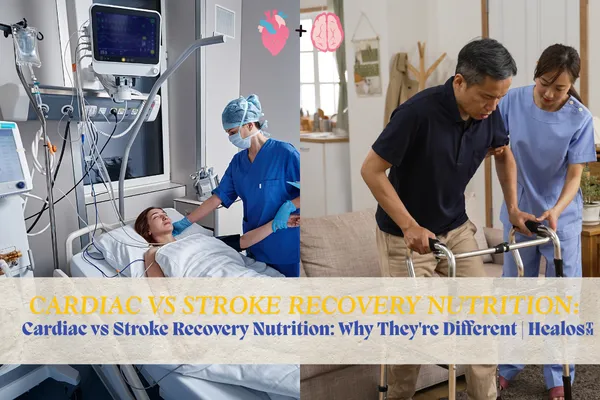
Cardiac vs Stroke Recovery Nutrition: Why They're Different | Healos™
A heart attack and a stroke often begin the same way: a narrowed or blocked blood vessel, a clot, a sudden loss of oxygen. So it's natural to assume that recovery, including the nutrition that supports it, should look the same too.
It shouldn't. The blood vessels are shared; the organ being rebuilt is not.
Here is the short answer. Heart and stroke recovery share the same vascular roots but repair different organs, so nutrition priorities differ. Heart recovery leans on EPA, CoQ10 for statin users and magnesium for diuretic users. Brain recovery leans on blood pressure, DHA and B vitamin status. Alpha-GPC is promising for the brain, but one large study linked it to higher stroke risk, so it needs a specialist conversation.
This article explains both sides, and why Alpha-GPC in particular changes the conversation rather than ending it.
简短的答案: 心梗和中风常常以同样的方式开始:血管狭窄或堵塞、血栓、突然缺氧,所以人们自然以为康复营养也应该一样。
其实不然:血管是共同的,要重建的器官却不同。
心脏康复偏重 EPA、他汀使用者的辅酶 Q10、利尿剂使用者的镁;大脑康复偏重血压、DHA 和 B 族维生素状态。Alpha-GPC 对大脑有前景,但一项大型研究将其与更高的卒中风险相关联,所以需要与专科医生讨论。
本文解释两方面,以及为什么 Alpha-GPC 改变了这场讨论,而不是给出了定论。
Same roots: what heart attack and stroke recovery have in common
Most ischaemic strokes and heart attacks share a common story. Atherosclerosis builds silently for years (see the 10-year cellular timeline). When blood flow is restored, tissue experiences a burst of oxidative stress known as reperfusion injury. Inflammation lingers for months. And survivors of both typically leave hospital on overlapping medications: statins, antiplatelet drugs and blood pressure treatment.
That shared foundation is why some parts of recovery are genuinely universal: stopping smoking, controlling blood pressure and LDL cholesterol, moving every day, sleeping well, managing mood and taking medications as prescribed. Early antioxidant support, such as the approach described in one molecule, three patients, applies to both groups as well.
The differences begin with a simple question: which organ is rebuilding, and what does it need that the other one doesn't?
相同的根源: 大多数缺血性中风和心梗有共同的故事:动脉粥样硬化悄悄形成多年;血流恢复时组织经历再灌注氧化应激;炎症持续数月;出院时用药也高度重叠——他汀、抗血小板药、降压药。
所以康复中有一部分是真正通用的:戒烟、控制血压和 LDL、每天活动、睡好、管理情绪、按时服药,早期的抗氧化支持也适用于两类患者。
差异从一个简单问题开始:正在重建的是哪个器官,它需要什么另一个器官不需要的东西?
What the heart needs most after a heart attack or stent
EPA, the triglyceride-lowering omega-3. The heart has the strongest omega-3 evidence of any organ, and most of it points to EPA. In the REDUCE-IT trial, 4 grams a day of a purified EPA drug called icosapent ethyl reduced major cardiovascular events by 25% in statin-treated patients with raised triglycerides (Bhatt et al., NEJM, 2019). That was a prescription product at a high dose, not an ordinary fish oil capsule, and it came with a small increase in atrial fibrillation and bleeding, so the details matter and belong in a conversation with your cardiologist.
Coenzyme Q10 for people on statins. Statins, essential after a heart attack, also lower the body's own production of coenzyme Q10, a molecule central to energy production in heart muscle. In one study, high-dose atorvastatin cut blood CoQ10 levels roughly in half within 30 days (Rundek et al., Archives of Neurology, 2004). Whether supplementing relieves statin-related muscle symptoms is still debated, but it is a reasonable question to raise (see statins deplete CoQ10).
Magnesium for people on diuretics. Loop and thiazide diuretics increase magnesium and potassium loss through the kidneys. Low magnesium is linked to heart rhythm problems, so levels deserve monitoring in anyone on long-term diuretics.
心梗或支架后,心脏最需要什么:
EPA:心脏拥有所有器官中最强的 Omega-3 证据,且大多指向 EPA。REDUCE-IT 试验中,每天 4 克纯化 EPA 药物(二十碳五烯酸乙酯)使他汀治疗、甘油三酯偏高的患者主要心血管事件减少 25%(NEJM 2019)——但这是高剂量处方药,不是普通鱼油,且房颤和出血略有增加,需与心脏科医生讨论。
辅酶 Q10:他汀会降低体内辅酶 Q10 的合成,一项研究中高剂量阿托伐他汀 30 天内使血液 CoQ10 降低约一半;补充能否缓解他汀相关肌肉症状仍有争议,但值得提出。
镁:袢利尿剂和噻嗪类利尿剂会增加镁和钾的排出,低镁与心律问题相关,长期服用利尿剂者应监测。
What the brain needs most after a stroke
Energy, and lots of it. The brain is about 2% of body weight but uses roughly 20% of the body's energy (Raichle & Gusnard, PNAS, 2002). Recovering brain tissue is rebuilding connections, which is metabolically expensive. That is one reason post-stroke fatigue is so common and so different from ordinary tiredness.
Blood pressure above almost everything. High blood pressure is the single most important modifiable risk factor for another stroke. Nutrition that supports blood pressure control, especially less salt and more potassium-rich vegetables where your kidneys and medications allow, often matters more than any supplement.
DHA, the structural omega-3. While the heart's evidence points to EPA, DHA is the dominant omega-3 in brain cell membranes. Human evidence that DHA supplements improve stroke recovery is still limited, so the most reliable source remains food, such as oily fish twice a week, unless your team advises otherwise.
B vitamins, with nuance. Folate, vitamin B6 and B12 lower homocysteine, an amino acid linked to vascular risk. In the CSPPT trial of 20,702 adults with high blood pressure in China, adding folic acid to blood pressure treatment reduced first strokes by 21% (Huo et al., JAMA, 2015). But in people who had already had a stroke, the VITATOPS trial found no significant reduction in major vascular events overall (Lancet Neurology, 2010). The lesson: B vitamin status matters, especially B12 in people taking metformin or long-term acid-reducing medicines, but high-dose B vitamins aren't a proven shield against a second stroke.
Protein and safe swallowing. Many stroke survivors have difficulty swallowing, which makes it harder to eat enough protein to rebuild muscle. A speech-language pathologist can advise on safe textures.
中风后,大脑最需要什么:
能量:大脑约占体重 2%,却消耗约 20% 的能量(PNAS 2002),恢复中的脑组织在重建连接,代谢代价很高,这也是卒中后疲劳如此常见且与普通疲劳不同的原因之一。
血压几乎高于一切:高血压是再次中风最重要的可控风险因素,少盐、在肾功能和药物允许时多吃富钾蔬菜,往往比任何补充剂都重要。
DHA:心脏证据指向 EPA,而 DHA 是脑细胞膜中最主要的 Omega-3;补充 DHA 改善卒中康复的人体证据仍有限,最可靠的来源仍是食物(如每周两次油性鱼)。
B 族维生素需要细看:CSPPT 试验中,20,702 名中国高血压成人在降压基础上加叶酸,首次卒中减少 21%(JAMA 2015);但对已发生卒中者,VITATOPS 试验未发现主要血管事件总体显著减少。
结论:B 族维生素的「状态」重要(尤其服用二甲双胍或长期抑酸药者的 B12),但高剂量 B 族不是防止二次中风的已证实屏障。蛋白质与安全吞咽:很多卒中幸存者存在吞咽困难,言语治疗师可指导安全的食物质地。
Where Alpha-GPC fits: a brain-specific nutrient
Alpha-GPC (L-alpha-glycerylphosphorylcholine, also called choline alfoscerate) is a form of choline that crosses the blood-brain barrier. Inside the brain, choline is used to make acetylcholine, a chemical messenger involved in attention and memory, and phosphatidylcholine, a building block of nerve cell membranes. That is exactly why it has attracted interest in stroke recovery, where both communication between nerve cells and the repair of their membranes matter.
The human evidence is older and limited. The largest study in stroke followed 2,044 patients with recent stroke or transient ischaemic attack in Italy who received Alpha-GPC, and reported improvements in neurological and cognitive scores (Barbagallo Sangiorgi et al., Annals of the New York Academy of Sciences, 1994). But that study had no control group, so it cannot show how much of the improvement was due to Alpha-GPC rather than natural recovery. Alpha-GPC is also used in some countries as a prescription medicine for cognitive decline.
That is a reasonable basis for interest. It is not a basis for claiming that Alpha-GPC repairs the brain.
Alpha-GPC 的位置:一种大脑专属营养素: Alpha-GPC(L-α-甘油磷酸胆碱,又称胆碱阿福酯)是能穿过血脑屏障的胆碱形式。在大脑中,胆碱用于合成与注意力和记忆相关的神经递质乙酰胆碱,以及构成神经细胞膜的磷脂酰胆碱——这正是它在卒中康复中受到关注的原因。
但人体证据较早且有限:规模最大的卒中研究在意大利纳入 2,044 名近期卒中或 TIA 患者,报告神经和认知评分改善(1994),但没有对照组,无法区分是 Alpha-GPC 的作用还是自然恢复。它在部分国家作为处方药用于认知下降。这足以构成关注的理由,但不足以声称 Alpha-GPC 能修复大脑。
The Alpha-GPC study every stroke survivor should know about
Here is why Alpha-GPC changes the conversation. In 2021, researchers analysed health records from about 12 million adults in South Korea's national health system. After adjusting for other risk factors, people who had used Alpha-GPC had a 46% higher risk of stroke over 10 years than those who had not (Lee et al., JAMA Network Open, 2021).
A possible explanation involves the gut. Bacteria in the intestine can convert choline into a compound that the liver turns into TMAO (trimethylamine N-oxide), and higher TMAO levels have been linked to cardiovascular events (Tang et al., NEJM, 2013). Whether this explains the Korean finding is not yet known.
It is important to read this study carefully. It was observational, so it shows an association, not proof that Alpha-GPC causes strokes. People prescribed Alpha-GPC in Korea may have differed from non-users in ways the researchers couldn't fully measure, including early cognitive decline, which itself carries vascular risk. But for a nutrient being considered specifically after a stroke, it is a finding no honest discussion can skip.
What this means for you:
Don't start Alpha-GPC on your own. Discuss it with your neurologist and pharmacist, who can weigh your stroke type, risk factors and medications.
If it is used, it should stay within the product's licensed purpose, which is nutritional support, not treatment.
Blood pressure control, antiplatelet or anticoagulant therapy, statins and rehabilitation remain the foundation. No nutrient replaces them.
每位卒中幸存者都应了解的 Alpha-GPC 研究: 这就是 Alpha-GPC 改变讨论的原因。2021 年研究者分析了韩国国民健康系统约 1,200 万成年人的数据,调整其他风险因素后,使用过 Alpha-GPC 的人 10 年卒中风险高 46%(JAMA Netw Open 2021)。
一种可能的解释与肠道有关:肠道细菌可将胆碱转化,肝脏再生成 TMAO,而较高的 TMAO 与心血管事件相关(NEJM 2013),但是否能解释韩国的发现尚不清楚。
需要谨慎解读:这是观察性研究,只显示关联,不能证明 Alpha-GPC 导致中风;使用者可能在研究者无法充分测量的方面与非使用者不同,包括本身就带有血管风险的早期认知下降。但对于一种专门在中风「之后」考虑使用的营养素,这是任何诚实讨论都不能跳过的发现。
对你意味着:不要自行开始服用 Alpha-GPC,请与神经科医生和药剂师讨论;如使用,应限于产品许可的营养支持用途,而非治疗;血压控制、抗血小板或抗凝治疗、他汀和康复训练仍是基础,没有任何营养素能替代。
How Healos builds different plans for heart and brain recovery
The Healos approach starts with a diagnosis and a medication list, not a product list. The free H-Index Audit asks whether you're recovering from a heart event, a stroke or congenital heart surgery, and what you take, because those two answers change the priorities.
For heart recovery, the emphasis falls on nutrients commonly affected by cardiac medications and on EPA-focused omega-3 support. For stroke recovery, the emphasis shifts toward the brain's energy needs, DHA, B vitamin status and blood pressure-friendly habits. Alpha-GPC appears only in stroke-specific plans, and only as a topic for review with your neurologist and pharmacist, positioned as nutritional support within its licensed use.
The Complete Recovery & Longevity programme follows the full first year in four quarters, because the brain in particular keeps reorganising for many months after a stroke, and heart and brain priorities can shift as medications change. Both paths run alongside your specialists' care and never replace it.
Healos 如何为心脏和大脑制定不同方案: Healos 从诊断和用药清单开始,而不是从产品清单开始:免费 H-Index 审计会询问你是在心脏事件、中风还是先心病手术后康复,以及正在服用什么,因为这两个答案会改变优先级。
心脏康复侧重心脏药物常影响的营养素和以 EPA 为主的 Omega-3 支持;卒中康复侧重大脑的能量需求、DHA、B 族维生素状态和有利于血压的习惯。Alpha-GPC 只出现在卒中专属方案中,且仅作为与神经科医生和药剂师共同审阅的议题,定位为许可范围内的营养支持。
年度全面康复方案按四个季度覆盖完整的第一年,因为大脑在卒中后会持续重组数月,心脑重点也会随药物调整而变化。两条路径都与专科治疗并行,从不替代。
The bottom line
Your heart and your brain are fed by the same blood vessels, but they are rebuilt in different ways. After a heart attack, EPA, CoQ10 and magnesium often rise to the top. After a stroke, blood pressure, brain energy, DHA and B vitamin status take priority. Alpha-GPC is the most brain-specific nutrient in the conversation, and the most important one to discuss openly with your neurologist, because the evidence cuts both ways.
结论: 心脏和大脑由同样的血管供养,却以不同方式重建。心梗后,EPA、辅酶 Q10 和镁常居首位;中风后,血压、大脑能量、DHA 和 B 族维生素状态优先。Alpha-GPC 是这场讨论中最「大脑专属」的营养素,也是最需要与神经科医生公开讨论的一个,因为证据指向两个方向。
Frequently asked questions
What supplements are different for stroke recovery versus heart recovery? Heart recovery often focuses on EPA omega-3, coenzyme Q10 for people on statins and magnesium for people on diuretics. Stroke recovery places more weight on blood pressure control, DHA, B vitamin status and adequate protein. Always discuss supplements with your care team first.
Is Alpha-GPC safe after a stroke? The answer isn't settled. Alpha-GPC supplies choline to the brain and has been studied in stroke recovery, but a 2021 Korean cohort of about 12 million adults linked its use to a 46% higher 10-year stroke risk. The study was observational, but stroke survivors should only consider Alpha-GPC after discussing it with their neurologist and pharmacist.
Do B vitamins prevent a second stroke? Not reliably. Folic acid reduced first strokes in a large trial of adults with high blood pressure in China, but in people who had already had a stroke, the VITATOPS trial found no significant overall reduction in major vascular events. Checking B12 status is still worthwhile, especially for people on metformin or long-term acid-reducing medicines.
Should stroke survivors take DHA or EPA? EPA has the strongest evidence for heart outcomes, while DHA is the main omega-3 in brain cell membranes. Evidence that DHA supplements improve stroke recovery is limited, so eating oily fish is a reasonable starting point. Ask your team before taking high-dose omega-3, especially with blood thinners.
Why does stroke recovery need a different nutrition plan from heart recovery? Both conditions share the same vascular roots, but the brain has unique needs: it uses about 20% of the body's energy, relies on DHA-rich membranes and is especially sensitive to blood pressure. Heart recovery is shaped more by cardiac medications and heart muscle energy.
常见问题:
心脏和卒中康复的补充剂有何不同?心脏侧重 EPA、他汀使用者的 CoQ10、利尿剂使用者的镁;卒中更重视血压、DHA、B 族维生素状态和充足蛋白质,请先与医疗团队讨论。
中风后服用 Alpha-GPC 安全吗?尚无定论:它向大脑提供胆碱并在卒中康复中被研究过,但 2021 年韩国约 1,200 万人的队列研究将其与 10 年卒中风险高 46% 相关联;虽是观察性研究,卒中幸存者应与神经科医生和药剂师讨论后再考虑。
B 族维生素能预防二次中风吗?不可靠:叶酸在中国高血压人群中减少了首次中风,但 VITATOPS 在已卒中者中未见主要血管事件总体显著减少;检查 B12 状态仍有价值。
卒中后吃 DHA 还是 EPA?EPA 心脏证据最强,DHA 是脑细胞膜主要 Omega-3,DHA 改善卒中康复证据有限,吃油性鱼是合理起点;服用抗凝药者使用高剂量 Omega-3 前请咨询。
为什么卒中康复需要不同的营养方案?大脑消耗约 20% 能量、依赖富含 DHA 的细胞膜、对血压特别敏感;心脏康复更多受心脏药物和心肌能量影响。
References
Bhatt DL, et al. Cardiovascular risk reduction with icosapent ethyl for hypertriglyceridemia (REDUCE-IT). New England Journal of Medicine. 2019;380:11–22.
Rundek T, et al. Atorvastatin decreases the coenzyme Q10 level in the blood of patients at risk for cardiovascular disease and stroke. Archives of Neurology. 2004;61(6):889–892.
Raichle ME, Gusnard DA. Appraising the brain's energy budget. PNAS. 2002;99(16):10237–10239.
Huo Y, et al. Efficacy of folic acid therapy in primary prevention of stroke among adults with hypertension in China (CSPPT). JAMA. 2015;313(13):1325–1335.
VITATOPS Trial Study Group. B vitamins in patients with recent transient ischaemic attack or stroke. Lancet Neurology. 2010;9(9):855–865.
Barbagallo Sangiorgi G, et al. Alpha-glycerophosphocholine in the mental recovery of cerebral ischemic attacks: an Italian multicenter clinical trial. Annals of the New York Academy of Sciences. 1994;717:253–269.
Lee G, et al. Association of L-α glycerylphosphorylcholine with subsequent stroke risk after 10 years. JAMA Network Open. 2021;4(11):e2136008.
Tang WHW, et al. Intestinal microbial metabolism of phosphatidylcholine and cardiovascular risk. New England Journal of Medicine. 2013;368:1575–1584.