#6 Fontan Liver Disease & Nutrition: Managing FALD in ACHD
-The Heart-Liver Conspiracy: Navigating Fontan Circulation and the Silent Fight for Hepatic Longevity
#Fontan Circulation #FALD #ACHD Hepatic Complications #Cellular Antioxidants #Toronto ACHD Program
When a Right Turn Reroutes an Entire Ecosystem
For adults who underwent the Fontan procedure during childhood, survival into maturity is nothing short of a profound surgical masterclass. This brilliant innovation completely re-engineered human network physiology, taking a complex, single-ventricle congenital defect and elegantly rerouting systemic venous blood directly to the pulmonary arteries without the luxury of a subpulmonary pump. It is, by all definitions, a structural triumph.
However, nature operates as a strictly balanced ledger. In bypassing the right ventricle, the Fontan architecture strikes a silent, long-term compromise with another vital organ: the liver.
In the day-to-day rhythm of outpatient life, a subtle conspiracy unfolds beneath the ribs. While a patient may feel clinically stable, exercising and attending regular check-ups at premier centers like the Toronto ACHD Program or the University of Ottawa Heart Institute, their liver is quietly bearing the brunt of an unusual hemodynamic reality. This progressive condition, known as Fontan-Associated Liver Disease (FALD), is one of the most frequently under-screened and misunderstood comorbidities in modern adult congenital heart disease (ACHD) management.
At Healos™ Canada, we believe that an advanced structural repair deserves an equally sophisticated metabolic safety net. Patients should not have to navigate the complex heart-liver connection in isolation, nor should their recovery be left to chance. True longitudinal care requires extending our clinical vision beyond episodic imaging and stepping onto the microscopic battlefield of cellular preservation.
The Downstream Congestion: Deconstructing the FALD Cascade
To understand why FALD is nearly universal among long-term Fontan survivors, we have to look at the plumbing of the system. In a standard anatomy, the right side of the heart actively vacuums blood out of the hepatic veins, keeping abdominal pressures low. In a Fontan circulation, because blood must passively coast through the lungs without a pump pushing it forward, central venous pressure (CVP) is chronically elevated—frequently hovering between $10 to $20{ mmHg}.
This permanent back-pressure acts like a slow-moving systemic traffic jam, transmitting a relentless hydrostatic burden directly into the delicate vascular beds of the liver. This pressure creates a highly specific, subacute pathophysiological cascade:
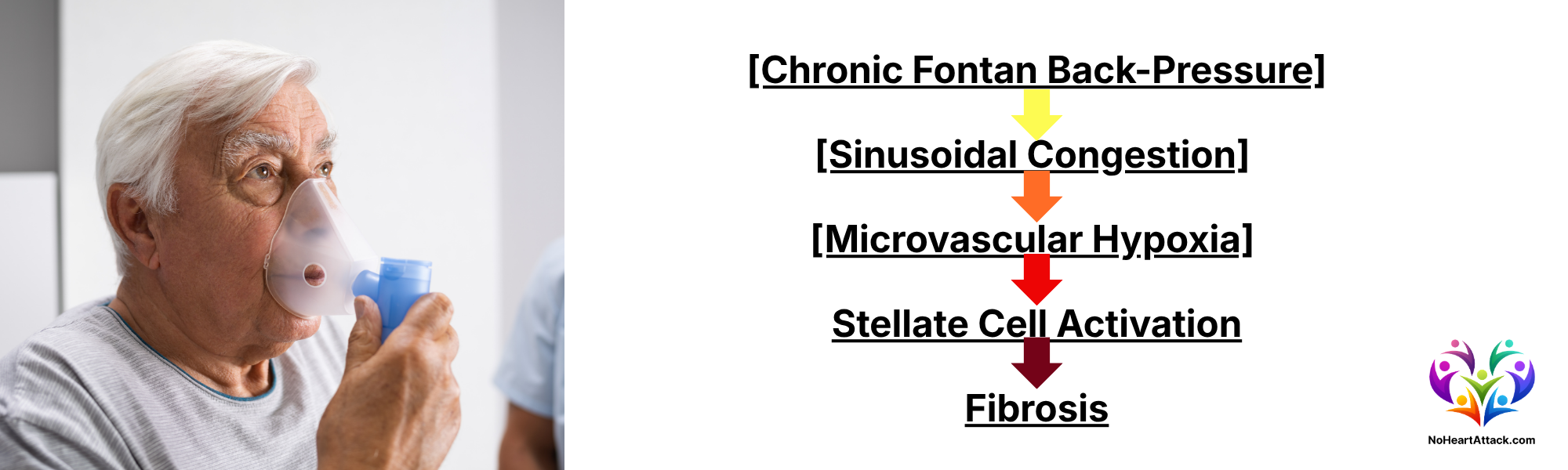
Sinusoidal Dilatation: The microscopic capillaries within the liver (sinusoids) are forced to dilate to accommodate the chronic fluid backup, disrupting the precise architecture of the hepatic plates.
Microvascular Hypoxia: The combination of stagnant fluid congestion and baseline low cardiac output starves neighboring hepatocytes of fresh, oxygen-rich blood, creating localized zones of persistent hypoxia.
Oxidative Stress and Stellate Cell Exploitation: Cellular suffocation triggers a massive, localized production of Reactive Oxygen Species (ROS). This oxidative trauma acts as a dangerous signaling flare, activating hepatic stellate cells—the quiet architects of scar tissue. Once activated, they begin laying down collagen, steadily transforming soft, functional tissue into rigid, fibrotic pathways.
The true danger of FALD lies in its incredibly sneaky timeline. The liver is a notoriously stoic organ; it does not complain early. A Fontan adult can possess significant, advancing hepatic fibrosis while maintaining entirely normal baseline liver enzymes (ALT/AST). By the time standard blood panels flag a warning, the tissue architecture has often already shifted toward advanced fibrosis or cirrhosis, paving the way for portal hypertension or worse.
The Surveillance Gap: Bridging the 2025 Guidelines with Daily Reality
The international cardiology community has recognized the urgency of this blind spot. The recent 2025 ACC/AHA guidelines introduced explicit, updated mandates urging clinicians to execute annual, proactive liver surveillance—utilizing specialized imaging, biomarkers, and elastography (FibroScan)—for all high-risk adult Fontan cohorts.
Yet, out in the real world, a substantial implementation gap remains. When patients transition away from specialized academic hubs and back into community care or long-term care (LTC) facilities across Ontario, the continuity of this intensive oversight can easily falter:
Insufficiency of Screenings: Due to systemic bottlenecks, many patients receive detailed hepatic imaging only every 2 to 3 years, leaving a highly vulnerable window where subclinical fibrosis can silently progress.
The Communication Deficit: Because the heart-liver connection is rarely discussed in standard health education, many patients remain entirely unaware that their congenital heart history directly impacts their hepatic longevity.
The Absence of Standardized Prevention: While guidelines tell us when to look, conventional medicine offers virtually no standardized, proactive therapeutic options to protect hepatic tissue from hemodynamic stress before structural decay sets in.
The Healos™ Canada Framework: A Practical, Ground-Level Protective Tool
The Healos™ Canada Integrative Recovery Architecture serves as the operational link that brings the 2025 ACC/AHA guidelines to life inside the patient's home. We do not replace the critical diagnostic decisions of a patient's ACHD cardiologist or hepatologist; instead, we deploy a highly automated, cell-level defense system designed to protect hepatocytes from oxidative stress every single day.

1. Precision Anti-Fibrotic and Antioxidant Bio-Nutrition
To mitigate a condition driven by chronic hypoxia and oxidative stress, we must supply the liver with maximum-bioavailability, medical-grade substrates designed to neutralize free radicals before they can activate fibrotic pathways:
Mitochondrial Resuscitation Matrix: Integrating a targeted synergy of Coenzyme Q10 (CoQ10), Pyrroloquinoline Quinone (PQQ), and Alpha-Lipoic Acid (ALA). This combination helps sustain ATP production within oxygen-starved hepatocytes, preventing cellular necrosis and subsequent inflammatory signaling.
Endothelial and Sinusoidal Stabilization: Supplying ultra-pure, standardized Omega-3 fatty acids (EPA/DHA in structured triglyceride form). These essential lipids actively work to downregulate local pro-inflammatory eicosanoids and preserve the elastic compliance of the hepatic microcirculation.
Defending the Gut-Liver Axis: Chronic Fontan congestion also affects the digestive tract, increasing intestinal wall permeability and allowing harmful bacterial endotoxins to leak directly into the portal vein—a process that severely aggravates liver inflammation. Healos™ incorporates targeted, non-irritating prebiotics and polyphenols to reinforce the gut barrier and ease the liver's detoxification workload.
2. Continuous 24/7 AI-Driven Surveillance
Through our automated Task Control Console and our intelligent conversational companion, Clawbot, Healos™ continuously monitors subtle, non-linear trends that human eyes often miss between clinic appointments. The system tracks daily fluctuations in energy architecture, appetite consistency, localized abdominal comfort, and hydration trends. If a patient's data begins to drift toward a pattern of hepatic stress or fluid retention, the console flags the variance immediately. Furthermore, the system automates the tracking of the patient's health schedule, reminding them precisely when their annual FibroScan or ultrasound is due under the 2025 guidelines.
3. Strengthening the Clinical Alliance
Healos™ operations are built for seamless, transparent collaboration. We provide community physicians, pharmacists, and academic specialists with structured, data-dense recovery logs that outline exact nutritional compliance and biometric trends. This turns the black box of outpatient life into an open book, enabling care teams to collaborate effortlessly to preserve the patient's long-term health sovereignty.
📚 Peer-Reviewed References & Clinical Literature
FALD Pathophysiology and Prevalence:
The Journal of the American College of Cardiology (JACC): Comprehensive reviews outlining the mechanical impact of chronic central venous hypertension on sinusoidal remodeling and the development of Fontan-Associated Liver Disease.
NCBI PubMed Central - Hepatic Complications of the Fontan Circulation
The 2025 ACC/AHA Congenital Heart Disease Surveillance Guidelines:
Circulation: Updated clinical practice guidelines establishing the mandate for structured, annual multi-disciplinary liver health assessments and tracking protocols for the aging ACHD population.
Oxidative Stress and Hepatic Stellate Cell Activation:
American Journal of Physiology - Gastrointestinal and Liver Physiology: Investigative data exploring how hypoxia-induced reactive oxygen species ($ROS$) trigger the fibrotic cascade and demonstrating the mechanistic benefits of targeted mitochondrial antioxidants.
The Gut-Liver Axis in Congenital Hemodynamics:
European Heart Journal: Research evaluating how systemic venous congestion alters intestinal mucosal integrity and exploring the subsequent inflammatory impact on downstream hepatic tissue.
