
#2 Cachexia in ACHD: The Hidden Post-Surgery Malnutrition Crisis
- Undernutrition and Cachexia in Adult Congenital Heart Disease: The Clinical Blind Spot That Worsens Surgical Outcomes
#ACHD #Cardiac Cachexia #Cellular Nutrition #Post-Surgery Recovery #Ottawa Health
The Paradox of Structural Success vs. Metabolic Decline
After a masterfully executed cardiac surgery, an adult living with congenital heart disease (ACHD) should theoretically be on a linear trajectory toward renewed vitality. Whether recovering at a premier surgical center like the University of Ottawa Heart Institute or returning home to a community setting in Eastern Ontario, the structural correction of the heart is celebrated as a definitive victory.
Yet, far too often, a quiet crisis unfolds in the months that follow. The patient experiences a progressive, frustrating wave of physical weakness, unexplainable weight loss, persistent fatigue, and a steady decline in functional capacity. When these concerns are brought to light, busy clinical teams frequently attribute them to "the expected exhaustion of post-surgical recovery," "general deconditioning," or simply the inevitable reality of "aging."
In reality, these individuals are often caught in the grip of cardiac cachexia—a severe, highly complex, and systemic form of metabolic undernutrition that silently undermines the most brilliant surgical successes. Recent multi-center cohort data, including crucial insights from the Pathfinder-ACHD Registry, reveals a sobering truth: up to 30% to 40% of adult congenital heart disease patients exhibit definitive signs of malnutrition or subacute cachexia, with the hazard ratio peaking dramatically during the post-operative window. This is not a minor, self-correcting side effect; it is a profound clinical blind spot that drives up 30-day readmission rates, accelerates skeletal muscle wasting, and fundamentally shortens long-term survival.
At Healos™ Canada, we recognize that true cardiothoracic recovery cannot occur in a metabolic vacuum. Healing requires a deliberate, system-wide intervention that addresses this nutritional crisis at the cellular level—transforming post-discharge care from a passive waiting period into an active, automated pipeline of biological restoration.
The Hidden Pathophysiology: Deconstructing the Cachectic Cascade
Cardiac cachexia is fundamentally distinct from simple starvation or a lack of appetite. It is an aggressive, hypermetabolic, and pro-inflammatory state where the body systematically consumes its own lean tissue to maintain baseline cardiovascular homeostasis. This destructive loop is driven by a triad of distinct physiological forces:
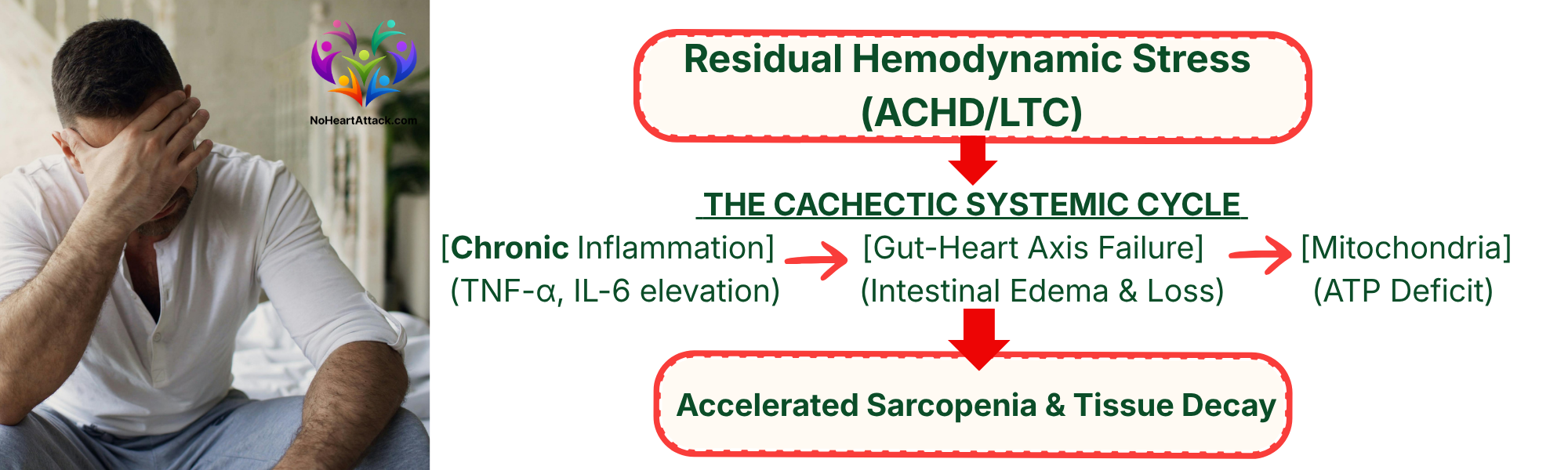
Persistent Hemodynamic Overload: Even after structural repair, many ACHD patients retain subtle, residual hemodynamic abnormalities—such as right ventricular dysfunction or the fragile fluid dynamics of a Fontan circulation. This forces the myocardium to work significantly harder, elevating resting energy expenditure by 20% to 30% above normal baselines.
Immune-Driven Proteolysis: The physical trauma of cardiopulmonary bypass triggers a prolonged, sterile immune response. Chronic elevation of pro-inflammatory cytokines, specifically Tumor Necrosis Factor-alpha (TNF-\alpha) and Interleukin-6 (IL-6), acts as a systemic switch that suppresses the vital anabolic mTOR pathway, accelerating skeletal muscle protein breakdown (sarcopenia) while simultaneously blunting the brain’s appetite signals.
The Fractured Gut-Heart Axis: Subclinical right-sided heart strain induces chronic venous congestion within the splanchnic circulation. This leads to subtle intestinal wall edema, microvilli degradation, and a profound disruption of the gut microbiome. Consequently, even when a patient consumes food, their ability to absorb micronutrients, amino acids, and essential lipids is severely compromised.
At the deep cellular level, this creates an energetic catastrophe. Mitochondria within both skeletal muscle and remaining cardiomyocytes become highly dysfunctional, losing their ability to efficiently generate ATP. Standard clinical metrics like Body Mass Index (BMI) or serum albumin are deceptively inadequate here; they frequently remain within "normal" ranges due to fluid retention and occult edema, masking advanced muscle wasting until the patient has hit a point of severe, non-linear depletion.
The Macro Systemic Deficit: Why standard Outpatient Models Fail
Despite a wealth of peer-reviewed data warning of the dangers of cachexia, structured nutritional surveillance remains completely fragmented within the standard North American cardiology landscape. This systemic neglect is driven by clear structural bottlenecks:
The Episodic Assessment Gap: A standard 15-minute follow-up appointment every three months leaves zero room for a comprehensive, multi-dimensional nutritional audit.
Diagnostic Misattribution: Because cachexia is traditionally taught as an end-stage heart failure phenomenon, clinicians rarely screen for it in the immediate post-surgical or subacute phase, frequently dismissing muscle loss as "post-operative deconditioning."
The Post-Discharge Disconnect: Once a patient transitions out of specialized tertiary centers in Ottawa or Toronto and back into community care or Long-Term Care (LTC) environments, specialized metabolic tracking disappears entirely.
The patient is left to navigate an incredibly complex web of long-term prescription medications—many of which further suppress appetite or alter metabolic absorption—without a dedicated, defensive architecture to restore their fundamental nutrient reserves.
The Healos™ Canada Solution: Precision Metabolic Reclamation
The Healos™ Canada Integrative Recovery Architecture explicitly solves this post-discharge vulnerability. By unifying 24/7 digital biomarker intelligence with targeted, cell-level bio-nutrition, we establish an automated safety net that catches and reverses cachectic trends before they manifest as a clinical crisis.
1. The 32-Dimension Automated Task Control Console
Rather than relying on sporadic, inaccurate in-clinic weight checks, Healos™ utilizes an automated digital control console to track the patient's recovery ecology in real time. Our AI systems continuously monitor trends in Heart Rate Variability (HRV), sleep architecture, and subjective fatigue metrics, running non-linear pattern recognition across 32 critical health dimensions. If a patient's biometric data indicates early mitochondrial exhaustion or a subclinical cachectic drop, the system flags the variance immediately, allowing for preventative dietary and clinical adjustments.
2. Advanced Bio-Nutrition for Mitochondrial and Muscle Preservation
To successfully break the cachectic cycle, the body must be flooded with highly specialized, hyper-absorbable cellular substrates designed to bypass the compromised gut barrier and downregulate systemic inflammation:
Endothelial and Cytokine Modulation: Deploying premium, high-purity Omega-3 fatty acids (EPA/DHA in structured, maximum-bioavailability triglyceride form). These compounds actively replace arachidonic acid in cell membranes, suppressing the production of inflammatory eicosanoids and stabilizing the vascular endothelium.
Mitochondrial Resuscitation Matrix: Introducing a precise synergy of Coenzyme Q10 (CoQ10), Pyrroloquinoline Quinone (PQQ), and L-Carnitine. This specific cluster directly fuels the electron transport chain, restoring cellular energy production, reversing profound fatigue, and providing the metabolic currency required for tissue repair.
Anabolic Muscle Preservation: Utilizing pre-digested, bioactive protein peptides and branched-chain amino acids (BCAAs). These components stimulate protein synthesis directly within skeletal muscle tissue without placing an osmotic or metabolic overload on compromised hepatic or renal pathways.
Gut Barrier Reconstruction: Incorporating targeted, non-irritating prebiotics and anti-inflammatory polyphenols to reduce intestinal wall permeability, resolve micro-edema, and optimize the gut-heart axis for maximum nutrient assimilation.
Empowering the Clinical Alliance
Healos™ Canada operates as a powerful clinical force multiplier.
We do not alter or compete with the vital prescriptions of a patient's primary cardiologist or surgeon; instead, we act as their extended eyes and ears inside the home.
By providing a highly structured, automated, and hyper-personalized delivery system for daily lifestyle pacing, biometric monitoring, and cellular nutrition, Healos™ ensures near-perfect adherence to the foundational pillars of health. We relieve the clinical team of the immense labor of daily outpatient surveillance while providing the patient with the absolute certainty and structural support needed to move from a state of fragile, fearful survival into a life of resilient, long-term autonomy.
📚 Peer-Reviewed References & Clinical Literature
Cachexia Prevalence and the Pathfinder-ACHD Registry:
International Journal of Cardiology: Detailed clinical registry analysis illuminating the high prevalence of undernutrition and cachexia across adult congenital cohorts, demonstrating its direct correlation with increased post-operative morbidity.
NCBI PubMed Central - Cardiac Cachexia in Congenital Heart Disease
Inflammatory Mechanisms of Muscle Wasting in Heart Failure:
Circulation (American Heart Association): Comprehensive exploration of cytokine-mediated proteolysis ($TNF-\alpha$, $IL-6$) and mitochondrial damage within skeletal muscle during chronic and subacute cardiac stress states.
The Gut-Heart Axis and Nutritional Malabsorption:
European Heart Journal: Investigative research tracking the pathophysiological effects of intestinal congestion, gut mucosal barriers breakdown, and subsequent cachectic progression in complex cardiovascular patients.
Omega-3 and Mitochondrial Therapies in Advanced Cardiovascular Recovery:
The American Journal of Clinical Nutrition: Clinical trials evaluating the impact of structured, high-bioavailability Omega-3 fatty acids combined with mitochondrial co-factors ($CoQ10/PQQ$) on reversing lean mass loss and improving systemic functional capacity.
